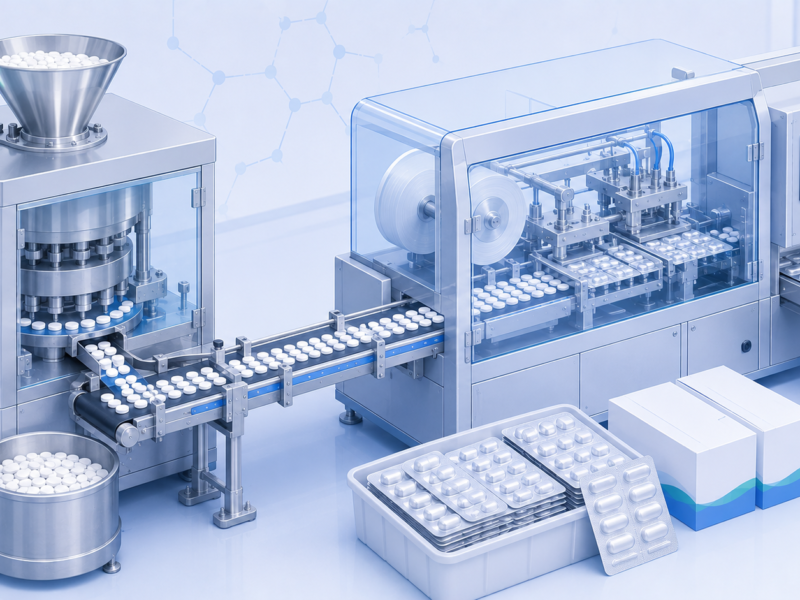
Tablets are the workhorse of any pharma brand’s catalogue, which is exactly why getting them made well, cheaply and at scale decides whether your range turns a profit. Tablet third party manufacturing lets you put your brand on a compressed dosage that someone else presses, coats and packs on an audited line. But “a tablet” hides a lot of choices — whether it’s film-coated or enteric-coated, packed in a blister or a bottle, run at 50,000 units or half a million. Those choices move your cost per strip far more than the headline rate ever will. Here’s how to think about them before you sign.
Key takeaways (TL;DR)
- The coating type — uncoated, film, enteric or sustained-release — changes both the manufacturing complexity and your shelf appeal.
- Blister versus bottle packing is a real cost and positioning decision, not a default; each suits different products and channels.
- Tablets reward volume more than almost any other form: per-unit cost drops sharply as batch size climbs.
- Minimum order quantities are usually set by the batch the machine runs efficiently, not by an arbitrary number.
- A Drug License, GST and your brand artwork are enough to begin — the maker handles formulation and compression.
Why tablets are the easiest form to outsource
Of all the dosage forms a brand can hand to a contract maker, tablets are the most forgiving. They run on standard GMP lines rather than sterile cleanrooms, they tolerate long shelf lives, and the machinery to compress and coat them is mature and widely available. That keeps rates competitive and lead times predictable. For a marketing company or franchise owner building a first catalogue, tablets are usually where you start — broad therapeutic coverage, low per-unit cost and packaging that ships and stores without fuss.
The flip side is that competition is fierce, so your edge rarely comes from the molecule alone. It comes from how the tablet is finished and presented: a cleanly film-coated tablet in a well-printed blister simply sells better than a bare tablet in a plain strip, even when the active inside is identical.
Coating types: what they do and when to choose them
Coating is the single most important specification you’ll set after the molecule itself. It affects taste-masking, swallowability, stability and the price you can command on the shelf. Here’s the practical menu most contract makers offer:
| Coating type | What it does | Typical use case |
|---|---|---|
| Uncoated | Plain compressed tablet, lowest cost, fast to make | High-volume generics, chewables, low-cost lines |
| Film-coated | Thin polymer layer for taste-masking, easier swallowing, branding colour | Most branded oral tablets where presentation matters |
| Enteric-coated | Resists stomach acid so the tablet releases lower in the gut | Actives that irritate the stomach or degrade in acid |
| Sustained-release (SR) | Releases the active gradually over hours | Once-daily convenience positioning, smoother release profile |
As a rule of thumb, complexity rises as you move down that list, and so does cost. Uncoated is cheapest and fastest; enteric and SR involve specialised coating and tighter testing, which raises both the rate and the minimum batch. Pick the coating that the product genuinely needs, then decide whether a step up in finish earns its keep in shelf appeal.
Blister versus bottle: the packing decision
Once the tablet is made, how it’s packed shapes both cost and how it sells. The two mainstream routes pull in different directions.
- Blister (strip) packing — tablets sealed individually in an Alu-PVC or Alu-Alu strip. Protects each tablet, looks clinical and branded, and is the default for prescription and pharmacy retail in India. Alu-Alu costs more than PVC but gives better moisture protection for sensitive actives.
- Bottle (HDPE) packing — loose tablets in a sealed plastic bottle, often with a desiccant. Cheaper per tablet at high counts, common for institutional supply, OTC vitamins and large therapy quantities, but offers less per-unit branding surface.
For most branded retail products in India, blister wins on trust and shelf presence. Bottle packing earns its place when you’re shipping large counts to hospitals or running a high-volume supplement line where unit economics beat presentation. Many brands run the same tablet in both formats for different channels.
The economics of high-volume tablets
Tablets reward scale like no other form. A compression machine has a fixed setup cost per batch — cleaning, line clearance, granulation, validation samples — and that cost is spread across however many tablets the run produces. Double the batch and you barely add setup, so the per-tablet cost falls. This is why a quote for 50,000 tablets and a quote for 500,000 tablets can look like two different businesses on a per-strip basis.
The drivers below are what actually sit behind your number:
| Cost lever | Effect on per-tablet price |
|---|---|
| Batch size | Larger runs spread fixed setup costs, lowering per-unit cost sharply |
| Coating | Uncoated cheapest; film moderate; enteric and SR add coating and testing cost |
| Active ingredient | The molecule’s raw-material price can dominate the total |
| Packing format | Alu-Alu blister > Alu-PVC blister > bottle, on a per-tablet basis |
| Print and artwork | Multi-colour cartons and foils add to packing cost |
Treat any per-tablet figure as indicative until you hold a written quote for your exact molecule, coating, batch size and packing.
Understanding minimum order quantities
The minimum order quantity (MOQ) for a tablet is rarely arbitrary — it’s tied to the smallest batch the equipment can run economically and validate properly. Below that threshold the setup cost per tablet becomes punishing, so makers set a floor. A few things worth knowing before you negotiate:
- MOQ scales with coating complexity. Enteric and SR tablets often carry higher minimums than plain or film-coated ones because the coating run itself has a minimum economic size.
- Each new SKU has its own MOQ. Ten products at minimum batch is a larger commitment than one product at a big batch — plan your launch range accordingly.
- Packing minimums exist too. A custom carton or foil may carry its own minimum print run separate from the tablet batch.
- Higher volume unlocks better rates. If you can commit to a larger batch up front, the per-tablet price almost always improves.
Documents and steps to get started
Getting a tablet line moving is refreshingly light on paperwork compared with sterile forms. You’ll typically need:
- A Drug License (wholesale or manufacturing, as applicable to your setup)
- GST registration
- Your brand name and trademark or registration details
- A product list naming the molecule, strength, coating and packing you want
From there the flow is straightforward: share the brief, receive a quote with net rates and MOQs, submit your papers, approve the blister and carton artwork, then let the maker handle compression, coating, QC and packing before dispatch.
Biozia Lifesciences manufactures tablets across its catalogue of 250+ formulations on WHO-GMP and ISO-certified lines from Yamunanagar, Haryana — offering uncoated, film, enteric and sustained-release options in both blister and bottle packs, alongside capsules, syrups and the sterile injectables, IV infusions and eye drops most makers can’t supply. With pan-India distribution and leadership carrying 40+ years in pharma, it’s built to scale a tablet range from a first launch to high-volume supply.
Planning a tablet range? Request a manufacturing quote from Biozia Lifesciences →
Related guides
- Third-Party Pharma Manufacturing in India
- Capsule Third-Party Manufacturing in India
- Herbal & Ayurvedic Third-Party Manufacturing
- Injectable Third-Party Manufacturing in India
Frequently asked questions
What’s the difference between film-coated and enteric-coated tablets?
A film coating is a thin layer that masks taste, eases swallowing and adds colour for branding. An enteric coating is engineered to resist stomach acid so the tablet releases lower in the digestive tract — useful for actives that irritate the stomach or break down in acid. Enteric is more specialised, so it usually costs more and carries a higher minimum batch.
Should I choose blister or bottle packing?
For branded retail and prescription products in India, blister packing is the default — it protects each tablet and looks clinical on the shelf. Bottle (HDPE) packing is cheaper per tablet at high counts and suits institutional supply or large-quantity OTC lines. Many brands use both formats for different channels.
How low can the per-tablet cost go?
It depends mostly on batch size, coating and the molecule. Because fixed setup costs are spread across the run, larger batches cut the per-unit price significantly. Uncoated tablets in simple packing at high volume are the cheapest; enteric or SR tablets in premium foils cost more. Always work from a written quote for your exact spec.
What is a typical MOQ for tablets?
MOQs are set by the smallest batch the equipment can run efficiently, so they vary by coating and product rather than being a fixed number. Plain and film-coated tablets generally have lower minimums than enteric or SR tablets. Each separate SKU carries its own MOQ, so plan your launch range around that.
What paperwork do I need to start a tablet line?
A Drug License and GST registration are the essentials, plus your brand or trademark details and a product list specifying molecule, strength, coating and packing. The contract maker handles formulation, compression, coating and quality testing on its certified line.
Author: Biozia Lifesciences Editorial Team — insights drawn from Biozia Lifesciences’ WHO-GMP & ISO-certified manufacturing and PCD franchise operations in India, led by 40+ years of industry experience. This article is general business information and not medical or legal advice.
Interested in a Biozia PCD Franchise?
Get monopoly rights, a wide product range and full marketing support in your territory.