Reviewed by Anil Kumar Goel, B.Pharm — Chairman, Biozia Lifesciences, 40+ years in the pharmaceutical industry.
An Ayurvedic PCD franchise lets you market a herbal company’s branded products in your area, usually with exclusive territory rights, while the company handles manufacturing, licences and quality control. Interest in herbal liver, women’s health and joint-care products keeps growing among chemists and doctors, but the rules differ from allopathic PCD, and a weak partner can cost you months. This guide covers how the model works, the licence basics, how costs are structured, how to evaluate a company, and the mistakes new franchise partners commonly make.
Key takeaways (TL;DR)
- An Ayurvedic PCD franchise means marketing a company’s herbal brands in an assigned territory; the company manufactures and holds the manufacturing licences.
- Ayurvedic products fall under the Drugs and Cosmetics Act and are licensed by the State Licensing Authority, not the same route as allopathic formulations.
- Costs are mainly stock, promotional material, field-staff expenses and your own registrations; ask every company for a written breakdown.
- Judge a partner on licences, composition transparency, label compliance, batch documentation and territory terms, not on the size of the product list.
- Herbal products are supportive; they must never be promoted as replacing prescribed treatment.
- Check territory exclusivity in writing before you pay for anything.
What an Ayurvedic PCD franchise actually involves
PCD stands for Propaganda-cum-Distribution. You promote and sell a company’s herbal brands to doctors, chemists and stockists in your area. The company manufactures the products, holds the licences, and supplies stock against your orders. You build the market.
In an Ayurvedic range the products are usually syrups, oils, tablets, capsules and churnas, positioned around liver and digestive care, women’s health, bone and joint comfort, immunity and general tonics. Most are sold as supportive products, often by doctors who practise integrative or general medicine, and by chemists on counter demand.
Most good companies offer monopoly rights for a district or state, meaning no one else gets the same brand in your area. Read the monopoly clause carefully: it should state the exact territory, the products covered and the conditions for keeping the rights.
Next step: write down your territory, the doctor and chemist contacts you already have, and the therapy areas you are comfortable detailing. Use this list when you shortlist companies.
Licence and regulatory basics for Ayurvedic products
In India, Ayurvedic, Siddha and Unani drugs are regulated under the Drugs and Cosmetics Act, 1940 and its Rules, with a separate set of provisions from allopathic drugs. Manufacturing licences for these drugs are issued by the State Licensing Authority, usually linked to the state AYUSH or drug control department.
As the franchise partner, you generally are not the manufacturer, so the manufacturing licence belongs to the company. Still, you should check the following before you promote any product:
- A valid Ayurvedic manufacturing licence for the plant, covering the product category you are buying.
- The product’s licence number printed on the label, along with batch number, manufacturing and expiry details.
- A label that lists the ingredients and quantities and does not claim treatment of diseases the product cannot legally claim.
- GMP compliance for the manufacturing site. WHO-GMP and ISO certificates are a useful signal, but ask for copies and check the validity dates.
Advertising rules matter too. The Drugs and Magic Remedies (Objectionable Advertisements) Act restricts claims for certain diseases and conditions, so your visual aids and field talk should stay within what the label supports.
On your side, you will typically need business registration, GST and a bank account in the business name. Whether you need a separate sale licence for Ayurvedic products depends on the state and what you sell, so confirm this with your State Licensing Authority. If the company also supplies allopathic lines, those need the usual drug licence. See the documents required for a PCD franchise for a working checklist.
Next step: ask the company for copies of its manufacturing licence and GMP certificates, then verify them with the issuing authority before you place an order.

Cost structure: what you pay for and what to ask
A PCD franchise is usually cheaper to start than your own brand, but it is not free. Rather than chase a headline figure, ask each company to give you a written breakdown of these heads:
- Opening stock: the first order you place. Some companies set a minimum; others let you start small and scale up.
- Promotional material: visual aids, literature, samples and gift items. Find out which of these are free and which are charged.
- Field costs: medical representative salaries, travel and doctor meetings are your cost, not the company’s.
- Registrations and compliance: your own GST and any state requirement for stocking or sale.
- Logistics: who pays freight and how long dispatch takes after an order.
Margin comes from the gap between the company’s rate to you and the price at which you sell to the trade. Do not rely on a verbal margin. Ask for the rate list in writing, and find out how returns, near-expiry stock and damaged goods are handled. For a deeper look at how returns work, read our guide on PCD pharma franchise investment and profit margin in the related articles below.
Next step: request a rate list, minimum order terms and the returns policy from at least three companies, then compare the real cost of getting started.
Which herbal products to look for
A range should match the demand you actually see in your territory. Liver and digestive care, women’s tonics and joint comfort are common areas where doctors and chemists already recommend herbal options. A tight, relevant range is easier to detail than a catalogue of fifty items.
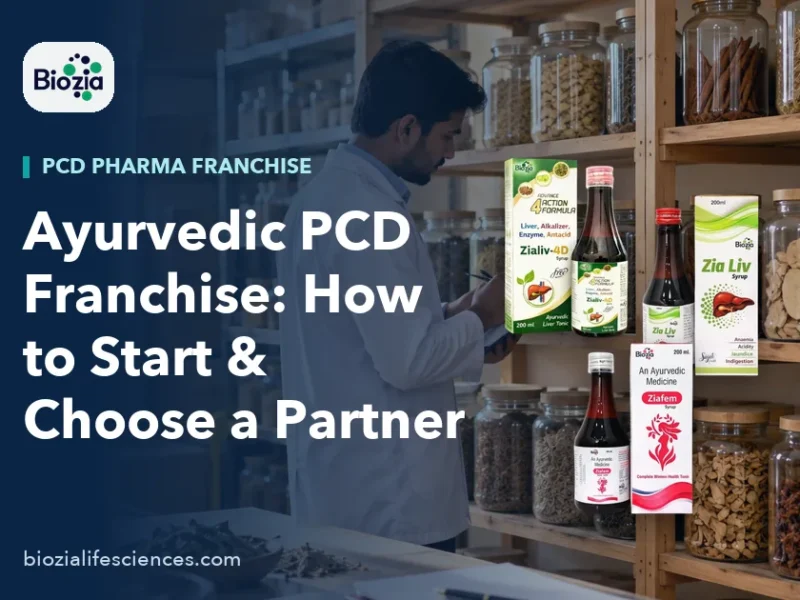
Biozia’s herbal range includes Zialiv-4D Syrup (S/F), a sugar-free liver and digestive supplement combining liver, alkaliser, enzyme and antacid actions, and Zia Liv Syrup (S/F), a sugar-free Ayurvedic liver health syrup. Ziafem Syrup is a polyherbal tonic for women’s general health.
For musculoskeletal care there is Bonzia Syrup, a polyherbal supplement containing herbs such as Hadjod, Shallaki, Ashwagandha, Haldi and Shilajeet, and Arkoil Pain Relief Oil, a polyherbal oil for external massage on muscles and joints. Arkoil is for external use only, and both products are supportive and do not replace prescribed treatment for arthritis, osteoporosis or other diagnosed conditions.
Whatever you promote, keep the message label-consistent: these are supplements that support health, and a doctor should assess any persistent symptom.
Next step: shortlist two or three therapy areas with strong local demand and ask the company for composition sheets for those products only.
How to evaluate an Ayurvedic PCD partner
Many companies look similar on a website. These checks separate a dependable partner from a risky one:
- Own manufacturing or a named facility. Ask where the products are made and whether you can visit. For brand-building you may later look at herbal and Ayurvedic third-party manufacturing as well.
- Composition transparency. You should be able to see the full formula and strengths per dose. If a company cannot tell you what is in a product, do not promote it.
- Batch documentation. Ask whether certificates of analysis are available on request and how the company handles a quality complaint.
- Written territory and exclusivity terms. Territory, duration, renewal conditions and what happens if targets are missed should all be on paper.
- Supply reliability. Check dispatch time, minimum order quantity and how stock-outs are handled.
- Support. Find out what training, literature and sample support is offered to your field team.
Call two or three existing franchise partners if the company will give references. Ask about payment terms, delays and how disputes were settled.
Next step: turn this list into a one-page scorecard and score each shortlisted company before you commit.

Common mistakes new partners make
These mistakes are avoidable if you spot them early:
- Choosing a company by the highest promised margin and ignoring quality and licences.
- Skipping the written agreement, or signing without reading the territory and termination clauses.
- Over-stocking in the first order before testing demand with doctors and chemists.
- Promoting herbal products with disease-treatment claims the label does not support, which can invite regulatory trouble and damage your credibility with doctors.
- Taking on too many therapy areas at once, so the field team cannot detail any of them well.
- Not tracking batch numbers and expiry on stock sold into the trade.
Starting small, focusing on a few products and keeping every term in writing will protect you better than any discount. If you are still working out the basics, our guide on how to start a PCD pharma franchise in India covers the general steps.
Next step: before paying anything, send the company your questions in writing and keep its replies on file. You can contact Biozia for composition sheets, licence copies and territory availability.
Interested in an Ayurvedic PCD franchise for your territory? Enquire with Biozia Lifesciences →
Related guides
- Monopoly Rights in PCD Pharma Franchise Explained
- Documents Required for a PCD Pharma Franchise
- Herbal & Ayurvedic Third-Party Manufacturing in India
Frequently asked questions
What is an Ayurvedic PCD franchise?
It is an arrangement where a herbal or Ayurvedic manufacturer gives you the right to market its branded products in a defined area. The company manufactures, holds the product licences and supplies stock. You handle promotion, sales to chemists and doctors, and local distribution, usually with exclusive territory rights written into the agreement.
Do I need an Ayurvedic licence to start?
As a franchise partner you usually rely on the manufacturer’s licence, since the company makes the products. Your own requirements, such as GST, business registration and any state-specific sale rules, vary by state. Confirm with your State Licensing Authority and ask the company to share its licence and GMP documents.
How much does it cost to start?
There is no fixed figure. Costs depend on the opening stock you order, promotional material, field staff, travel and your own registrations. Ask each company for a written breakdown of minimum order, free versus chargeable material, freight and returns, and compare these terms rather than only the headline margin.
Can Ayurvedic products be promoted for treating diseases?
No. Herbal supplements should be promoted in line with their label as supportive products. Do not claim they replace prescribed treatment, and avoid claims the Drugs and Magic Remedies (Objectionable Advertisements) Act restricts. Advise patients with persistent symptoms to consult a doctor.
How do I check whether a herbal company is genuine?
Ask for its manufacturing licence, GMP certificates and the licence number on product labels, then verify with the issuing authority. Check that full compositions are disclosed, request batch documentation, visit the plant if possible, and speak to existing franchise partners about supply and payment practices.
Can I get exclusive rights for my district?
Many companies offer monopoly rights by district or state, but terms differ. Get the territory, product list, duration and conditions for retaining exclusivity in the written agreement. A verbal assurance is not enough if another partner is later appointed in your area.
This article is general business information for pharma distributors and brand owners. Licensing rules and costs change; confirm current requirements with your State Drug Controller or a qualified consultant before acting.
Interested in a Biozia PCD Franchise?
Get monopoly rights, a wide product range and full marketing support in your territory.