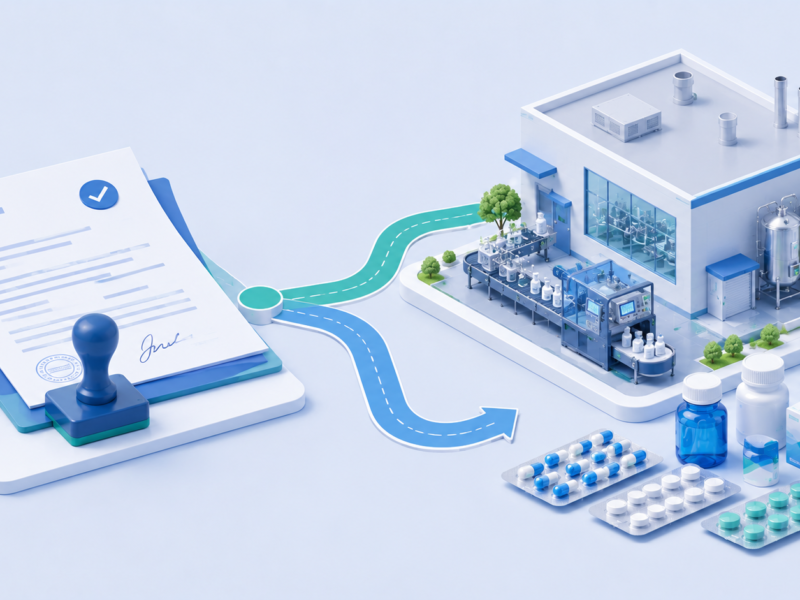
If you have built a pharma brand but don’t own a factory, two routes let you put product on the shelf without pouring crores into machinery. One is contract manufacturing. The other is loan licensing pharma — an arrangement where you hold the manufacturing licence in your own name and run your products on someone else’s approved plant. The two get confused constantly, yet they sit in different legal places and suit different kinds of buyers. This piece pulls them apart: what loan licensing actually means under Indian rules, who genuinely needs it, the paperwork the drug authorities expect, and where it helps or hurts.
Key takeaways (TL;DR)
- In loan licensing, you hold the manufacturing licence and hire space, equipment and staff at an already-approved factory — the plant is “lent” to you for your batches.
- In third-party manufacturing, the factory makes goods under its own licence and simply labels them with your brand; you need no manufacturing licence at all.
- Loan licensing suits established companies that want legal control of production; third-party suits marketers and start-ups who just want finished stock.
- A loan licence is granted under the Drugs and Cosmetics Rules and is tied to a specific host premises that already meets Schedule M.
- You gain ownership and accountability with loan licensing — but you also take on compliance liability, so weigh it against the simplicity of buying third-party.
What loan licensing actually means
The phrase sounds like a financial product, but it has nothing to do with money lending. In Indian drug regulation a loan licence is a manufacturing licence issued to a company that does not own a factory of its own. Instead, you formally arrange to use the manufacturing facilities — the building, plant, machinery and technical staff — of a unit that already holds a regular manufacturing licence. The host factory is, in effect, lending its approved infrastructure to you for the products listed on your licence. Crucially, the goods are still made under your name and your licence, and your company appears as the manufacturer on the label. You own the regulatory responsibility; you simply don’t own the bricks.
Loan licensing vs third-party manufacturing
Both models avoid building a plant, so people treat them as the same thing. They aren’t. The cleanest way to see the gap is to ask one question: whose licence is the product made under? In loan licensing it’s yours; in third-party (also called contract or P2P manufacturing) it’s the maker’s. That single difference cascades into who is liable, who controls the formulation, and how much paperwork you carry.
| Aspect | Loan licensing | Third-party manufacturing |
|---|---|---|
| Who holds the manufacturing licence | You (the brand owner) | The manufacturer |
| Whose name is on the label as manufacturer | Your company | The contract maker (with your brand) |
| Where production happens | The host factory’s approved premises | The manufacturer’s own factory |
| Regulatory liability for the product | Largely yours | Largely the manufacturer’s |
| Control over process & formulation | High — it is legally your product | Limited — you approve specs, they decide method |
| Paperwork burden on the brand | Heavier (you apply for and keep the licence) | Lighter (Drug License + GST usually enough) |
| Best fit | Established firms wanting ownership & scale | Marketers, franchise owners, first launches |
Who actually needs a loan licence
Loan licensing is not the default starting point — it’s a step up. It makes sense when you want the standing and control of being a licensed manufacturer without the capital and lead time of constructing your own Schedule M plant. Typical candidates include:
- Growing brands that have outgrown buying finished stock and want their own name on the manufacturing licence for credibility with tenders and institutional buyers.
- Companies eyeing exports, where some buyers and registrations prefer the brand owner to be the named licence holder.
- Firms protecting a proprietary formulation who want tighter legal control over how and where it is made.
- Businesses bridging a gap — building their own facility but needing to manufacture under their licence in the meantime.
If you simply want quality stock to sell under your brand with minimum red tape, third-party manufacturing is usually the lighter, faster choice. Loan licensing earns its keep when ownership and control are worth the extra compliance weight.
Licences and documents you’ll need
A loan licence is granted by the State Licensing Authority under the Drugs and Cosmetics Rules, and it is always tethered to a specific host factory that already holds a valid manufacturing licence and meets Schedule M. Expect to assemble:
- An application for the loan licence (the relevant manufacturing-licence form for the dosage forms you want).
- A no-objection / consent arrangement from the host manufacturer agreeing to lend the premises and facilities.
- Proof that the host unit’s licence, GMP status and Schedule M compliance are current.
- Details of your competent technical staff and the products to be made.
- Your GST registration, constitution documents and the usual fees.
Requirements and forms vary by state and by dosage form — treat this as an orientation, not a checklist, and confirm the exact set with the licensing authority and your host unit.
Pros and cons before you commit
The model rewards control and punishes complacency. On the upside, you skip the enormous cost and timeline of building and validating a plant, you manufacture under your own name, and you keep genuine say over your process. On the downside, the compliance accountability sits largely with you: if a batch fails an inspection, it’s your licence on the line, not just the factory’s. You’re also dependent on a host unit whose capacity and quality you don’t fully command. For sterile lines — injectables, IV infusions, eye drops — that dependency matters even more, because the facility bar is high and good sterile capacity is scarce. Pick a host whose certifications and sterile competence you would be proud to stake your own licence on.
Where Biozia Lifesciences fits
Whether you take the loan-licensing route or the simpler third-party path, the deciding factor is the same: the quality and breadth of the facility behind your brand. Biozia Lifesciences is a WHO-GMP and ISO-certified manufacturer in Yamunanagar, Haryana, producing more than 250 formulations across nine dosage forms — including the sterile injections, IV infusions and ophthalmic eye drops that many units simply cannot offer. With a leadership team carrying 40+ years in pharma and dependable pan-India supply, it’s the kind of Schedule M-compliant base that makes either model work in practice.
Comparing your options for loan licensing or contract production? Request a manufacturing quote from Biozia Lifesciences →
Related guides
- Third-Party Pharma Manufacturing in India
- Sterile Manufacturing & WHO-GMP
- WHO-GMP Certified Pharma Company
- How to Choose an Injectable Contract Manufacturer
Frequently asked questions
Does loan licensing mean borrowing money?
No. Despite the name, it has nothing to do with finance. It refers to a manufacturing licence held by a company that doesn’t own a factory and instead uses, or “borrows”, the approved premises and equipment of a unit that already holds a manufacturing licence.
How is a loan licence different from third-party manufacturing?
With a loan licence, you hold the manufacturing licence and the product is made under your name on a host factory’s premises. In third-party manufacturing, the factory makes the goods under its own licence and labels them with your brand, so you need no manufacturing licence yourself.
Who issues a loan licence in India?
It is granted by the State Licensing Authority under the Drugs and Cosmetics Rules, and it is tied to a specific host factory that already holds a valid manufacturing licence and meets Schedule M standards.
Is loan licensing better than buying third-party stock?
Neither is universally better. Loan licensing gives you ownership, control and standing as a licensed manufacturer, but heavier compliance responsibility. Third-party is lighter and faster for marketers and new brands. Match the model to how much control and liability you want to carry.
Can sterile products like injections be made under loan licensing?
Yes, provided the host factory holds the right sterile manufacturing approvals and meets aseptic Schedule M requirements for those forms. Because sterile capacity is specialised and limited, the host’s proven capability for injections, infusions and eye drops matters a great deal.
Author: Biozia Lifesciences Editorial Team — insights drawn from Biozia Lifesciences’ WHO-GMP & ISO-certified manufacturing and PCD franchise operations in India, led by 40+ years of industry experience. This article is general business information and not medical or legal advice.
Interested in a Biozia PCD Franchise?
Get monopoly rights, a wide product range and full marketing support in your territory.