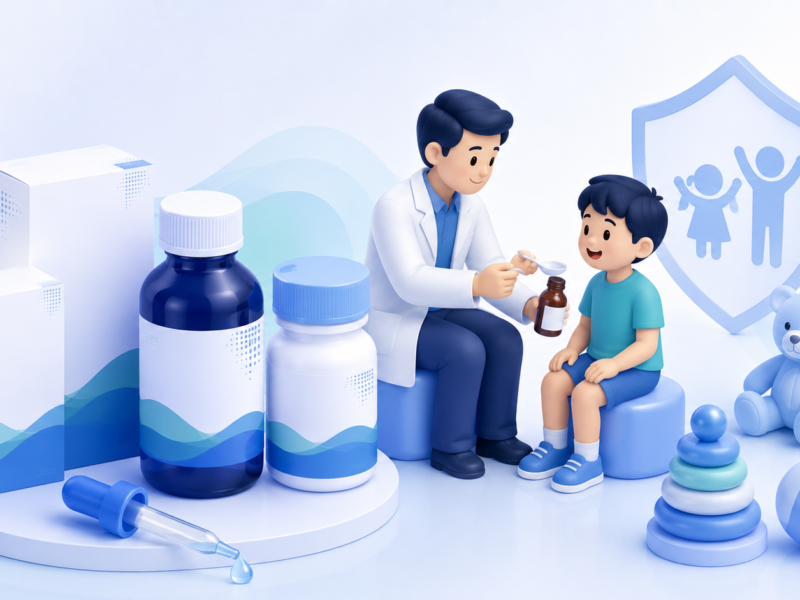
India sees a baby born every few seconds, and almost every one of them will, at some point, be handed a spoon of medicine rather than a tablet. That single fact is why a pediatric PCD pharma franchise can be one of the more durable niches an entrepreneur can build a distribution business around. Children can’t swallow solids easily, so the demand sits squarely in syrups, dry syrups and drops — a range with steady repeat ordering and clear monopoly potential. This guide breaks down the dosage forms that define the segment, what really drives demand, how territory rights work, and what to look for in a manufacturing partner.
Key takeaways (TL;DR)
- Pediatrics is an oral-liquid-led segment — syrups, suspensions, dry syrups and drops carry most of the volume, not tablets.
- Dry syrups (reconstituted with water before use) are a category worth understanding separately, because they ship and store differently from ready liquids.
- Demand is structurally repeatable: a young population, seasonal illness cycles and paediatricians who prescribe by brand keep reorders flowing.
- A monopoly (sole-territory) franchise gives you exclusive distribution in your district so you aren’t undercut by another partner of the same company.
- Pick your company on its oral-liquid range, flavour and packaging quality, and certifications — price comes after fit.
Why pediatrics is a liquid-first business
The defining constraint of the children’s segment is simple: a small child can’t take a tablet or capsule. That pushes almost the entire category into oral liquids and drops, where dose can be measured by spoon, cup or dropper and adjusted to a child’s weight. For a franchise partner this is good news, because liquids tend to be fast-moving consumables — a course finishes, the bottle empties, and the chemist reorders. The result is a product mix built around frequent, lower-value reorders rather than occasional big-ticket sales, which suits a distribution model that lives on relationships with local pharmacies and clinics.
The dosage forms that make up the segment
Not all “liquids” are the same, and the differences matter commercially — for shelf life, transport and how you stock them. Here is how the core pediatric forms compare:
| Dosage form | What it is | Typical use context | Commercial note |
|---|---|---|---|
| Syrups | Ready-to-use sweetened liquid | Everyday oral medicines for children | Fast-moving; flavour and bottle quality drive repeat preference |
| Suspensions | Liquid with active dispersed, shaken before use | Molecules not fully soluble as a syrup | “Shake well” labelling and uniform packaging matter |
| Dry syrups | Powder reconstituted with water by the chemist or caregiver | Actives that aren’t stable in liquid for long | Longer dry shelf life; lighter to transport before mixing |
| Oral drops | Concentrated liquid dosed with a dropper | Infants and very small volumes | Small packs, dropper accuracy is the selling point |
Dry syrups deserve a second look. Because the medicine sits as a dry powder until water is added, the product travels and stores as a stable powder and only becomes a short-life liquid once reconstituted. For a distributor that often means easier stock handling and less wastage from expiry on slow-moving lines.
What drives demand in this niche
The pediatric segment isn’t propped up by a single trend — several independent forces keep it moving:
- A young population. A large share of India’s people are children, and that base keeps the addressable demand wide across every district.
- Seasonal cycles. Monsoon and winter bring predictable spikes in common childhood ailments, so volumes recur on a calendar you can plan around.
- Brand-led prescribing. Paediatricians often prescribe by brand name, so a franchise that places its products with clinics builds sticky, repeating pull-through.
- Caregiver preference. Palatable flavours, clear measuring caps and trustworthy packaging influence which brand a parent buys again.
Taken together, these make the children’s range less cyclical and more dependable than many one-off therapy areas — a useful quality when you’re committing capital to stock and territory.
How monopoly (sole-territory) rights work
In a PCD franchise, “monopoly rights” mean the company appoints you as its sole distributor for a defined area — usually a district or a cluster of towns — and agrees not to sign another partner for the same products there. The practical value is protection: you can invest in building paediatrician relationships and pharmacy shelf space without a second franchisee of the same brand undercutting you next door. Before you sign, get the territory written down precisely (which areas, which product list), confirm how it’s enforced, and understand what happens if you don’t meet agreed offtake. Treat the boundary and the product list as the two things to nail in writing.
Choosing the right pediatric franchise company
Because this segment lives and dies on its liquid range, your shortlist criteria should look a little different from a general PCD evaluation:
- Depth of oral-liquid range — a real spread of syrups, suspensions, dry syrups and drops, not just a token few.
- Flavour and packaging — palatability, measuring caps and tamper-evident bottles that parents and chemists trust.
- Certifications — WHO-GMP and ISO compliance as the quality baseline.
- Clear monopoly terms — a written sole-territory agreement with a defined product list.
- Promotional support — visual aids, samples and packaging the company supplies to help you place brands with clinics.
- Supply reliability — consistent availability so you never disappoint a reordering pharmacy.
Biozia Lifesciences is a WHO-GMP and ISO-certified manufacturer with a dedicated oral-liquid range — syrups, suspensions and dry syrups — sitting within its 250+ formulations across nine dosage forms. Established in 2025 and based in Yamunanagar, Haryana, it offers pan-India PCD franchise partnerships with monopoly rights, backed by a leadership team carrying 40+ years in pharmaceuticals. Indicative franchise investment starts around ₹25,000–₹1,00,000 for a single territory; treat figures as indicative and confirm exact terms.
Want to build a children’s range in your district? Enquire about a PCD franchise with Biozia Lifesciences →
Related guides
- How to Start a PCD Pharma Franchise in India
- Antibiotics PCD Pharma Franchise
- Injectable PCD Pharma Franchise Opportunity
- Critical Care PCD Pharma Franchise in India
Frequently asked questions
What is a pediatric PCD pharma franchise?
It’s a propaganda-cum-distribution arrangement where a company appoints you to market and distribute its children’s medicines — mostly syrups, dry syrups, suspensions and drops — in a defined territory under its brands, often with monopoly rights.
What’s the difference between a syrup and a dry syrup?
A syrup is a ready-to-use liquid. A dry syrup is supplied as a powder that is mixed with water before use, which gives it a longer shelf life as a powder and makes it lighter to transport until it’s reconstituted.
How much does a pediatric franchise cost to start?
Indicative starting investment for a single territory is often in the region of ₹25,000 to ₹1,00,000, depending on your product list and stock. Always confirm the exact terms, minimums and margins in writing with the company.
What documents do I need to begin?
The essentials are a Drug License and GST registration. Beyond that, you’ll agree a product list and a written territory before placing your first order.
Why focus on oral liquids for children?
Young children generally can’t swallow tablets or capsules, so the segment is built around liquids and drops that can be measured by spoon, cup or dropper. That makes oral-liquid depth the single most important thing to assess in a pediatric franchise company.
Author: Biozia Lifesciences Editorial Team — insights drawn from Biozia Lifesciences’ WHO-GMP & ISO-certified manufacturing and PCD franchise operations in India, led by 40+ years of industry experience. This article is general business information and not medical or legal advice. Figures are indicative; confirm exact terms with the company.
Interested in a Biozia PCD Franchise?
Get monopoly rights, a wide product range and full marketing support in your territory.