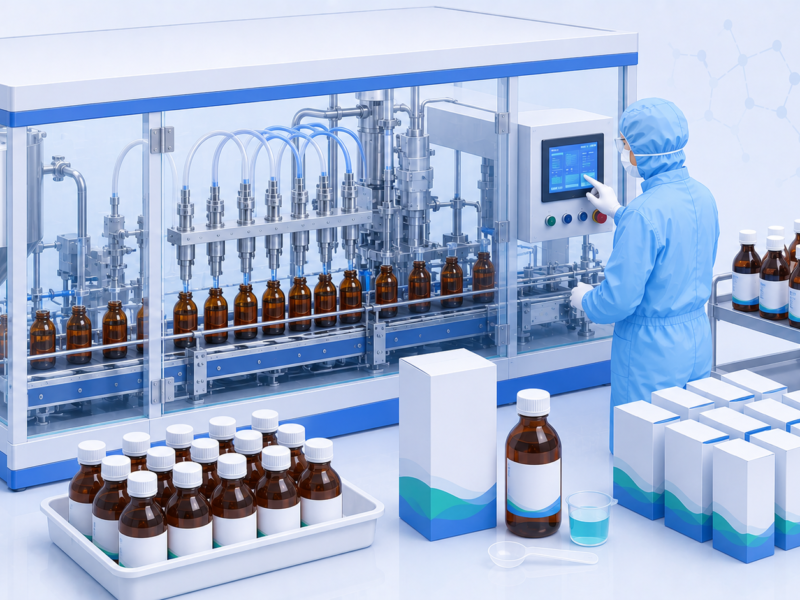
Oral liquids are often the first range a new pharma brand launches, and for good reason: they sell to almost every household, doctors prescribe them across age groups, and they are simpler to position than a sterile injectable. The catch is that making a stable, good-tasting liquid is harder than it looks. If you want your own bottled range without running a bottling hall yourself, syrup third party manufacturing is the route — a licensed maker formulates, flavours, fills and labels the product while you own the brand and the market. This guide covers what is specific to liquids: the syrup-versus-suspension choice, flavour and packaging options, realistic batch sizes and MOQs, and the papers you need to start.
Key takeaways (TL;DR)
- Syrups are clear solutions; suspensions carry insoluble particles and need a “shake well” formulation — the two are priced and packed differently.
- Flavour, colour and sweetener choices are part of the brief, not an afterthought — they decide whether a paediatric liquid actually gets taken.
- Liquids move in litres, so your MOQ is usually quoted as a batch volume that translates into thousands of bottles, not a flat bottle count.
- Packaging — bottle size, induction seal, measuring cup or dropper, mono-carton — can shift your per-bottle cost as much as the formula does.
- A Drug License and GST get you started; brand, artwork and a clear product list do the rest.
Syrup or suspension: which one do you actually need?
People use “syrup” loosely for anything in a bottle, but the formulation work behind a clear syrup and a cloudy suspension is genuinely different, and it affects your cost, shelf life and packaging. A syrup is a true solution — the active dissolves fully into a sweetened base and stays put. A suspension carries an insoluble drug as fine particles held in the liquid, which is why the label says “shake well before use”. Suspensions need suspending agents, careful particle work and tighter mixing control so the dose stays uniform from the first spoon to the last.
There is also the dry syrup — supplied as a powder you reconstitute with water at dispensing. Brands choose dry syrups when the molecule is unstable in water for long periods, because the clock only starts once it is mixed. Knowing which of the three your molecule belongs in is the first thing a manufacturer will confirm, and it is worth deciding before you ask for a quote.
| Type | What it is | Typical use | Label cue |
|---|---|---|---|
| Syrup | Clear solution, drug fully dissolved | Cough, tonics, antacids, paediatric ranges | Ready to use |
| Suspension | Insoluble drug held as fine particles | Many paediatric antibiotics, antacids | Shake well before use |
| Dry syrup | Powder reconstituted with water before use | Molecules unstable in water over time | Reconstitute before use |
Flavour, colour and packaging: the choices that sell the bottle
With a tablet, the patient swallows and moves on. With a liquid, taste is the product. A paediatric suspension that tastes bitter gets refused at the spoon, so flavour and sweetener selection is a real commercial decision, not a cosmetic one. Common flavour directions for the Indian market include orange, strawberry, raspberry, mixed-fruit and mint; sweetening can be done with sugar-based bases or sugar-free systems where the positioning calls for it. Colour is usually matched to the flavour, and some buyers deliberately choose a clear or dye-free presentation for a cleaner label claim.
Packaging is the other half of the per-bottle cost and the shelf appeal. The brief here is more detailed than for solids:
- Bottle size — 30 ml, 60 ml, 100 ml and 200 ml are the usual fills; smaller bottles cost more per ml to fill.
- Bottle material — amber or clear PET and glass, chosen for light protection and the look you want.
- Closure and seal — child-resistant caps, induction sealing and tamper-evidence for trust at the counter.
- Dosing aid — a measuring cup, spoon or dropper packed in, which matters most for paediatric ranges.
- Secondary pack — mono-carton, leaflet insert and outer shipper, all carrying your artwork.
Batch sizes and MOQ: why liquids are quoted in litres
This is where liquid sourcing surprises first-time buyers. A solid-dose order is easy to picture as a number of strips. Liquids are made in a manufacturing vessel, so the maker thinks in batch volume first and bottle count second. A single batch is a fixed quantity of bulk liquid that then fills into whatever bottle size you chose. The smaller the bottle, the more bottles one batch yields — the same run produces far more 30 ml bottles than 200 ml bottles.
That is why a minimum order quantity for liquids is usually expressed as a minimum batch, and why two products with the “same MOQ” can hand you very different bottle counts. When you compare quotes, ask the maker to translate the batch into a finished-bottle number for your exact fill size, and check what a top-up or repeat batch looks like — reorder economics matter more than the first run once your range starts moving.
| Cost driver | How it moves your per-bottle price |
|---|---|
| Molecule and base | The active plus the syrup or suspension base set the floor |
| Fill volume | Smaller bottles cost more per ml to fill and pack |
| Batch size | A larger batch spreads setup and cleaning over more bottles |
| Flavour and sweetener | Premium flavours and sugar-free systems add to the base cost |
| Packaging spec | Glass, droppers, child-resistant caps and cartons each add cost |
Treat any figure as indicative until you hold a written quote for your exact product, fill size and packaging.
Documents and a starter checklist
The paperwork to outsource a liquid range is the same backbone as any third-party order, with one or two liquid-specific details on the brief:
- Drug License (wholesale or manufacturing, as applicable to your setup)
- GST registration
- Brand name and trademark details
- A product list naming each molecule and whether it is a syrup, suspension or dry syrup
- Your flavour, sweetener, fill size and packaging preferences per product
Who sources oral-liquid ranges
Liquids attract a particular kind of buyer. PCD franchise partners and monopoly distributors like them because every clinic and chemist moves cough syrups, tonics and antacids, so a liquid range fills the trolley quickly. Marketing companies use them as entry products to seed a new territory before adding solids and specialities. Paediatric-focused brands lean on suspensions and flavoured syrups because that is where their audience lives. And entrepreneurs launching a first range often start with liquids precisely because the demand is broad and the prescribing is everyday rather than specialist.
Biozia Lifesciences manufactures syrups, suspensions and dry syrups as part of a 250+ formulation portfolio spanning nine dosage forms — from these oral liquids through to the sterile injections, IV infusions and eye drops many makers cannot offer. WHO-GMP and ISO certified and based in Yamunanagar, Haryana, with a leadership team carrying 40+ years in pharma, Biozia supplies pan-India and can grow a liquid range into a full multi-form portfolio as your brand scales.
Planning your own syrup or suspension range? Request a manufacturing quote from Biozia Lifesciences →
Related guides
- Third-Party Pharma Manufacturing in India
- Tablet Third-Party Manufacturing in India
- Capsule Third-Party Manufacturing in India
- Herbal & Ayurvedic Third-Party Manufacturing
Frequently asked questions
What is the difference between a syrup and a suspension?
A syrup is a clear solution in which the active ingredient is fully dissolved in a sweetened base. A suspension carries an insoluble drug as fine particles held in the liquid, which is why it must be shaken before each dose so the medicine stays evenly spread.
Can I choose my own flavour and bottle size?
Yes. Flavour, sweetener, colour, fill volume and packaging are all part of your brief. Common choices include orange, strawberry and mixed-fruit flavours, sugar or sugar-free bases, and 30 ml to 200 ml bottles with a measuring cup or dropper for paediatric ranges.
How is the minimum order quantity decided for liquids?
Liquids are made in a manufacturing vessel, so the minimum order is usually quoted as a batch volume rather than a flat bottle count. The same batch yields more small bottles than large ones, so ask the maker to convert the batch into a finished-bottle number for your exact fill size.
What is a dry syrup and when is it used?
A dry syrup is supplied as a powder that is reconstituted with water before use. Brands choose it for molecules that are not stable in water over a long shelf life, since the product only sits as a liquid once it is mixed at dispensing.
What documents do I need to start a third-party liquid order?
You need a Drug License and GST registration, plus your brand or trademark details and a product list stating each molecule and whether it is a syrup, suspension or dry syrup, along with your flavour and packaging preferences.
Author: Biozia Lifesciences Editorial Team — insights drawn from Biozia Lifesciences’ WHO-GMP & ISO-certified manufacturing and PCD franchise operations in India, led by 40+ years of industry experience. This article is general business information and not medical or legal advice.
Interested in a Biozia PCD Franchise?
Get monopoly rights, a wide product range and full marketing support in your territory.