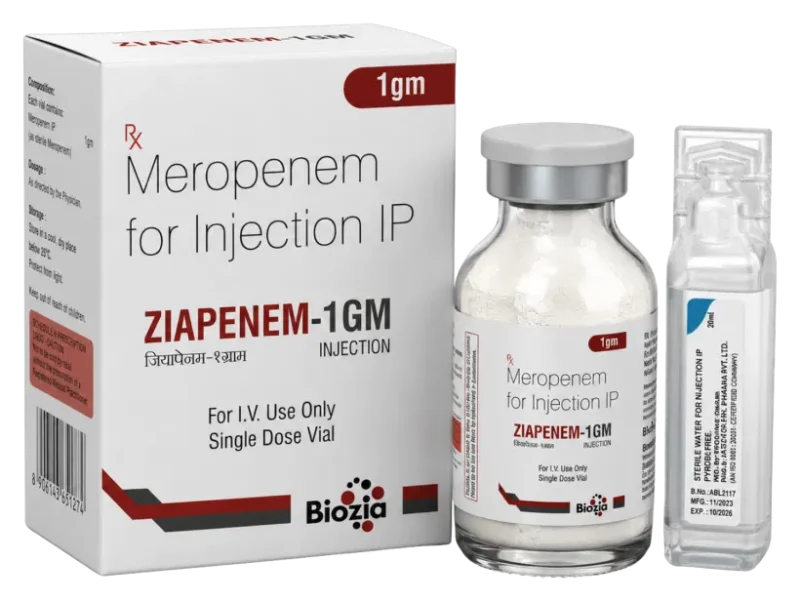
Ziapenm-1gm Injection
Meropenem 1gm
| Composition | Meropenem 1gm |
|---|---|
| Packing | Vial+Wfi |
| MRP | ₹ 1067 |
| Dosage Form | Injections |
About Ziapenm-1gm Injection
Ziapenm-1gm Injection contains Meropenem 1 gm, a broad-spectrum carbapenem antibiotic reserved for the treatment of serious and life-threatening bacterial infections in hospital settings. It is effective against a very wide range of bacteria, including many that are resistant to other antibiotics.
Biozia Lifesciences' Ziapenm-1gm is used in intensive care units and hospital wards to treat severe infections of the lungs, abdomen, brain, skin, urinary tract, and bloodstream, particularly when caused by multi-drug resistant organisms.
Uses of Ziapenm-1gm Injection
This medicine is commonly used for:
- Treating severe hospital-acquired and ventilator-associated pneumonia
- Managing life-threatening abdominal infections and peritonitis
- Treating bacterial meningitis caused by susceptible organisms
- Managing bloodstream infections and septicaemia
- Treating complicated urinary tract and skin infections in hospitalised patients
Indications
Indicated for the treatment of severe nosocomial and community-acquired infections caused by susceptible Gram-positive, Gram-negative, and anaerobic organisms, including: pneumonia (including nosocomial and VAP), febrile neutropenia, intra-abdominal infections (peritonitis, complicated appendicitis), bacterial meningitis (in adults and children over 3 months), complicated urinary tract infections, skin and skin-structure infections, septicaemia, and polymicrobial infections. It is a drug of last resort for infections caused by extended-spectrum beta-lactamase (ESBL) and carbapenem-sensitive multi-drug resistant organisms.
How Ziapenm-1gm Injection Works
Ziapenm-1gm works by attacking the outer wall of bacteria, causing it to collapse and the bacteria to die. It can defeat a very broad range of dangerous bacteria, including those that produce enzymes to resist many other antibiotics. Given directly into a vein, it reaches the site of infection rapidly and at high concentrations.
Mechanism of Action
Meropenem is a broad-spectrum carbapenem beta-lactam antibiotic that inhibits bacterial cell wall synthesis by binding with high affinity to penicillin-binding proteins (PBPs), particularly PBP-2 and PBP-3. This disrupts peptidoglycan cross-linking, causing osmotic instability and bacterial cell lysis. Meropenem's structural stability to hydrolysis by most beta-lactamases — including AmpC and many extended-spectrum beta-lactamases (ESBLs) — makes it effective against resistant organisms. It penetrates well into most tissues and fluids including the CNS, providing reliable coverage against aerobic and anaerobic Gram-positive and Gram-negative pathogens.
Key Benefits
- One of the broadest-spectrum antibiotics available, covering difficult-to-treat pathogens
- Stable against many bacterial resistance enzymes (beta-lactamases)
- Excellent tissue penetration including into the central nervous system
- A cornerstone of empirical therapy in critical care for severe infections
Did You Know?
Meropenem is one of the few antibiotics that can cross the blood-brain barrier effectively, making it one of the preferred treatments for bacterial meningitis caused by resistant organisms.
When & How to Take
Ziapenm-1gm is given as an intravenous injection or infusion strictly by trained healthcare professionals in a hospital setting. The dose and frequency are determined by the type and severity of the infection, as well as the patient's kidney function, and must be followed exactly as prescribed by your doctor.
Always follow the dosage and schedule advised by your doctor — this is general guidance only.
Possible Side Effects
Common side effects may include diarrhoea, nausea, vomiting, headache, and rash. Rarely, seizures may occur, particularly in patients with CNS disorders or kidney impairment. Clostridioides difficile-associated diarrhoea can occur during or after treatment. Tell your doctor if any side effect is severe or persistent.
Precautions & Safety
- Inform your doctor of any history of allergy to carbapenems, penicillins, or other beta-lactam antibiotics
- Use with extreme caution in patients with a history of seizures or CNS disorders
- Dose adjustment is essential in patients with kidney impairment
- Not for use outside a hospital or clinical setting — requires medical supervision throughout
- Complete the full prescribed course to prevent development of antibiotic resistance
Myths vs Facts
Carbapenem antibiotics like Meropenem can be prescribed for routine infections.
Carbapenems are reserved for severe, resistant, or life-threatening infections in hospital settings. Their use is strictly controlled to prevent the emergence of carbapenem-resistant bacteria.
If a stronger antibiotic is used first, recovery will be faster for any infection.
Overusing last-resort antibiotics like Meropenem contributes to the global antibiotic resistance crisis. Antibiotics should be matched to the causative organism and severity of infection.