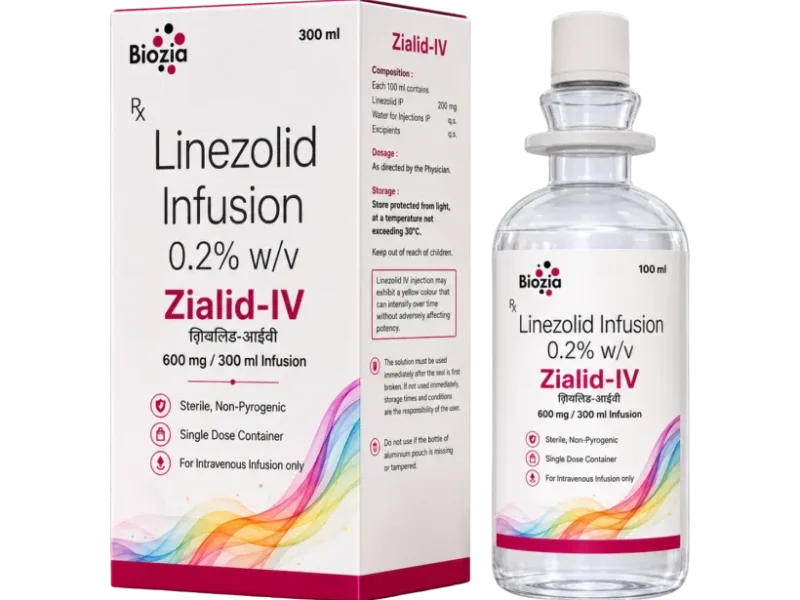
ZIALID-IV
LINEZOLID 200MG/100ML
| Composition | LINEZOLID 200MG/100ML |
|---|---|
| Packing | 300ml |
| MRP | UPCOMING |
| Dosage Form | Infusions |
About ZIALID-IV
ZIALID-IV is an intravenous infusion containing Linezolid 200mg/100ml — an oxazolidinone-class antibiotic administered in hospital settings for the treatment of serious Gram-positive bacterial infections, including those caused by methicillin-resistant Staphylococcus aureus (MRSA) and vancomycin-resistant Enterococci (VRE). It is indicated when oral therapy is not feasible or when the infection is severe enough to require hospitalisation.
As a bacteriostatic antibiotic with a unique mechanism of action unlike any earlier antibiotic class, Linezolid is a critical reserve antibiotic prescribed by specialist physicians for resistant and life-threatening infections.
Uses of ZIALID-IV
This medicine is commonly used for:
- Treating MRSA (methicillin-resistant Staphylococcus aureus) infections in hospital settings
- Managing vancomycin-resistant Enterococcal (VRE) infections
- Treating severe hospital-acquired pneumonia caused by Gram-positive organisms
- Managing complicated skin and soft tissue infections due to resistant bacteria
- Treating bacteraemia (bacteria in the bloodstream) associated with Gram-positive infections
Indications
Indicated for the treatment of infections caused by susceptible Gram-positive organisms including: nosocomial pneumonia caused by MRSA and Streptococcus pneumoniae; complicated skin and soft tissue infections including diabetic foot infections without osteomyelitis; community-acquired pneumonia with concurrent bacteraemia; and vancomycin-resistant Enterococcus faecium infections. Use is restricted to healthcare settings under infectious disease or microbiologist supervision due to resistance stewardship concerns.
How ZIALID-IV Works
Linezolid works at a very early stage of bacterial protein production — earlier than most other antibiotics. By interfering with the very first step of protein building inside the bacteria, it prevents the bacteria from making the proteins they need to survive and multiply. This unique action means it works against many bacteria that have become resistant to other types of antibiotics.
Mechanism of Action
Linezolid is a synthetic oxazolidinone that inhibits bacterial protein synthesis at the initiation stage, uniquely upstream of all other antibiotic classes that target ribosomes. It binds to the 23S ribosomal RNA of the 50S ribosomal subunit at a site that prevents formation of the 70S initiation complex (the joining of 30S and 50S subunits), thereby blocking translation initiation before elongation begins. Because its binding site does not overlap with macrolides, chloramphenicol, or lincosamides, cross-resistance does not occur. Linezolid is bacteriostatic against staphylococci and enterococci, and bactericidal against most streptococci. It achieves 100% bioavailability and can be transitioned to oral dosing without dose adjustment.
Key Benefits
- Active against MRSA and VRE — critical for serious resistant Gram-positive infections
- Unique mechanism of action with no cross-resistance to other antibiotic classes
- 100% oral bioavailability allows seamless IV-to-oral switch, reducing hospitalisation duration
- A vital reserve antibiotic for life-threatening resistant infections
Did You Know?
Linezolid has a very unusual property for an antibiotic — it achieves 100% bioavailability when taken orally, the same as when given intravenously. This means patients on IV Linezolid can be switched to oral tablets with no dose change, which is a major factor in allowing patients to leave hospital sooner while continuing their treatment at home.
When & How to Take
ZIALID-IV is administered intravenously by healthcare professionals in a hospital or clinical setting. The infusion is given over a prescribed duration as determined by the treating physician based on the infection type and severity. This is a hospital-administered medicine — do not attempt self-administration.
Always follow the dosage and schedule advised by your doctor — this is general guidance only.
Possible Side Effects
Common side effects include nausea, headache, diarrhoea, and vomiting. Myelosuppression — including thrombocytopenia (low platelet count) and anaemia — can occur, particularly with courses longer than two weeks; blood counts must be monitored. Serotonin syndrome is a risk when Linezolid is combined with serotonergic agents, as it inhibits monoamine oxidase. Optic neuropathy and peripheral neuropathy have been reported with prolonged use. Tell your doctor if any side effect is severe or persistent.
Precautions & Safety
- Inform your doctor about all medications you are taking — Linezolid has significant drug interactions, especially with serotonergic drugs, SSRIs, and MAOIs
- Blood counts must be monitored weekly during treatment, especially for courses exceeding two weeks
- Avoid tyramine-rich foods (aged cheeses, cured meats, fermented products) during treatment as Linezolid has weak MAO-inhibitory activity
- Inform your doctor if you have a history of blood disorders, hypertension, or seizures
- This is a reserve antibiotic — it should not be used for infections that can be treated with other agents; antibiotic stewardship is essential
Myths vs Facts
If a patient needs IV antibiotics, they must remain in hospital for the entire course.
Linezolid's 100% oral bioavailability means that once a patient is clinically stable, they can often be switched from IV ZIALID to oral Linezolid tablets and continue treatment at home — reducing the risk of hospital-acquired complications.
MRSA and other resistant infections cannot be treated effectively.
Reserve antibiotics like Linezolid are specifically developed and preserved for resistant organisms like MRSA and VRE. When prescribed appropriately by infectious disease specialists, they are highly effective against these difficult infections.