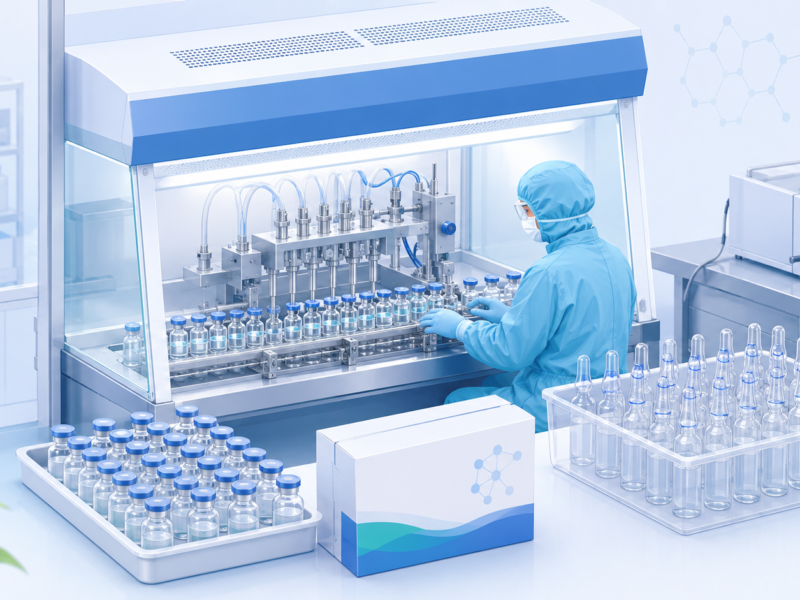
An injection is the least forgiving product a brand can put its name on. There is no swallowing reflex, no stomach acid, no liver between the medicine and the bloodstream — which is exactly why injectable third party manufacturing lives or dies on the cleanliness of the room it is made in. If you want to launch vials, ampoules or IV infusions under your own label, the question is never just “what’s the rate”. It is whether the partner you pick can prove a sterile environment, validated processes and the paperwork to back both. This guide breaks down the injectable types, the facility and validation realities, order minimums, packaging and the documents that get you started.
Key takeaways (TL;DR)
- Injectables split into dry-powder/lyophilized vials, liquid vials, ampoules and large-volume IV infusions — each needs its own filling line.
- Sterility is not a feature you add at the end; it comes from cleanroom-grade air, validated sterilisation and aseptic fill, all proven on paper.
- Order minimums on injectables run higher than tablets because a sterile batch and its media-fill validation carry fixed overhead.
- Primary packaging — the vial, ampoule, rubber stopper and seal — is part of the sterile product, not an afterthought.
- Vet an injectable maker on aseptic certification and validation records first, price last.
The injectable types you can outsource
“Injectable” is a family, not a single product, and the line that fills one type often cannot fill another. Knowing where your product sits decides which manufacturers can even quote you.
| Type | What it is | Typical use case |
|---|---|---|
| Dry powder / lyophilized vials | Drug filled as sterile powder or freeze-dried cake, reconstituted before use | Molecules unstable in liquid — many antibiotics, biologics |
| Liquid vials | Ready-to-use solution sealed in a multi- or single-dose vial | Stable small-volume injectables drawn by syringe |
| Ampoules | Sealed glass, single-dose, snapped open at the point of use | Single-shot drugs where no preservative is wanted |
| IV infusions (LVP) | Large-volume sterile fluids in bottles, bags or FFS containers | Hydration, electrolytes, drip-administered drugs |
A maker strong in liquid vials may not run a lyophilizer; an infusion line built for 100ml bottles is a different plant from an ampoule line. Match your range to a partner who genuinely operates the format you need.
Why the facility decides everything
With an oral tablet, a small defect usually means a rejected batch. With an injectable, a single contaminated unit is a patient-safety event. That is why sterile production is built around the air itself: cleanrooms are graded by particle count, the filling zone sits under the strictest grade with laminar airflow, and operators gown so that nothing they shed reaches an open vial. Three mechanisms keep a product sterile — either the sealed product is terminally sterilised, or a sterilising-grade filter removes organisms before an aseptic fill, or both. None of this is visible in a glossy brochure. It shows up only in environmental-monitoring logs and the discipline of the people in the room, which is why a verified sterile partner is far harder to replace than a tablet supplier.
Validation: the paperwork that proves sterility
“Trust us, it’s sterile” is not a quality system. A serious injectable maker can show that each safeguard was tested and documented before your product ever ran. When you audit a shortlist, ask to see evidence of:
- Process validation — proof that the filling and sterilisation method gives the same result batch after batch.
- Media fills — mock production runs using growth medium instead of drug to confirm the aseptic process stays sterile.
- Sterilisation cycle validation — autoclave or filter studies showing organisms are reliably destroyed or removed.
- Environmental monitoring — ongoing air, surface and water testing that the cleanroom holds its grade.
- Stability data — evidence the product stays within spec across its shelf life.
If a manufacturer cannot produce these on request, the price quote is meaningless — you are buying a risk, not a product.
Minimum order quantities and what drives them
Injectable MOQs almost always sit above oral-solid minimums, and the reason is structural rather than greedy. A sterile batch ties up a cleanroom, a validated line, sterilisation capacity and a round of release testing whether you make a thousand vials or fifty thousand. Spreading that fixed overhead is what pushes the floor up. Treat the figures below as indicative starting points to discuss, not fixed prices — confirm exact MOQs for your molecule and format in writing.
| Factor | Effect on minimum order |
|---|---|
| Format | Lyophilized vials and ampoules usually carry higher minimums than simple liquid vials |
| Molecule | Costly or hard-to-handle actives raise the minimum economical run |
| Changeover | Cleaning and re-validating a line between products adds fixed cost per batch |
| Packaging spec | Custom vial sizes, special stoppers or printed cartons lift the entry quantity |
Packaging is part of the sterile product
For an oral brand, packaging is mostly branding. For an injectable, the primary container is the product’s last barrier against the outside world. The glass quality of the vial, the rubber stopper that has to reseal after a needle, the aluminium flip-off seal and the integrity of an ampoule snap all decide whether sterility survives to the patient. Get these right with your maker before you obsess over carton artwork:
- Primary container — vial, ampoule, infusion bottle or bag, chosen for the drug and dose.
- Closure system — stopper and seal that keep the unit airtight and tamper-evident.
- Container-closure integrity — tested proof the seal holds across the shelf life.
- Secondary packaging — cartons, inserts and labelling that carry batch, expiry and regulatory text.
Documents and how to vet a sterile maker
To start a third-party injectable arrangement you will typically need a Drug License (wholesale or manufacturing as applicable), GST registration, your brand or trademark details, and a product list naming each molecule, strength, format and packaging. With papers in hand, the choice of partner comes down to capability you can verify rather than promises:
- Certification — WHO-GMP, ISO and Schedule M compliance for sterile manufacture.
- Format match — the actual lines for your type, be it lyophilized, liquid vial, ampoule or infusion.
- Validation evidence — media fills, sterilisation and process validation records on request.
- Quality control — in-house testing for sterility, endotoxins and particulate matter.
- Supply reliability — consistent release timelines and dependable pan-India dispatch.
Biozia Lifesciences is WHO-GMP and ISO certified and manufactures sterile injections and IV infusions — including products such as Linezolid IV injection and Paracetamol 1000mg/100ml infusion — as part of a 250+ formulation range across nine dosage forms. Operating from Yamunanagar, Haryana with pan-India supply and a leadership team carrying 40+ years in pharma, it is built for brands that need genuine sterile capability rather than a tablet line that “also does injectables”.
Planning an injectable or infusion range? Request a manufacturing quote from Biozia Lifesciences →
Related guides
- Third-Party Pharma Manufacturing in India
- IV Infusion & Fluid Third-Party Manufacturing
- Eye Drops Third-Party Manufacturing in India
- Dry Syrup Third-Party Manufacturing in India
Frequently asked questions
What is the difference between a liquid vial and a lyophilized vial?
A liquid vial holds a ready-to-use sterile solution, while a lyophilized vial holds a freeze-dried powder that is reconstituted with diluent just before use. Lyophilisation suits molecules that are not stable in liquid, but it needs a freeze-drying line, so fewer makers offer it.
Why are injectable order minimums higher than for tablets?
A sterile batch carries fixed costs — cleanroom time, line set-up and validation, sterilisation and release testing — that apply whatever the run size. Spreading that overhead is why injectable MOQs usually start above oral-solid minimums. Confirm exact quantities for your product in writing.
How can I verify a manufacturer’s sterile facility?
Ask for certification (WHO-GMP, ISO, Schedule M) plus evidence of process validation, media fills, sterilisation cycle data and environmental monitoring. A genuine aseptic maker can produce these records; one that cannot should not be trusted with injectables.
Does packaging affect the sterility of an injectable?
Yes. The vial or ampoule, the stopper and the seal form the final barrier protecting the product, and container-closure integrity must be tested across the shelf life. Primary packaging is part of the sterile product, not a cosmetic choice.
What documents do I need to start third-party injectable manufacturing?
You typically need a Drug License (wholesale or manufacturing as applicable), GST registration, your brand or trademark details, and a product list specifying each molecule, strength, injectable format and packaging.
Author: Biozia Lifesciences Editorial Team — insights drawn from Biozia Lifesciences’ WHO-GMP & ISO-certified manufacturing and PCD franchise operations in India, led by 40+ years of industry experience. This article is general business information and not medical or legal advice.
Interested in a Biozia PCD Franchise?
Get monopoly rights, a wide product range and full marketing support in your territory.