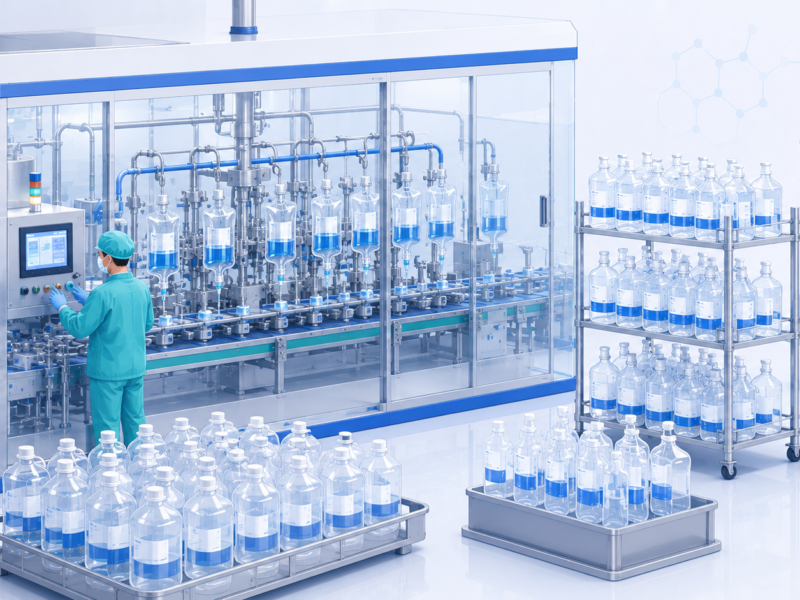
Large-volume drips are a different animal from a strip of tablets, and that catches most new brands off guard. IV infusion third party manufacturing lets you put your label on Paracetamol infusions, electrolyte fluids, antibiotics and other large-volume parenterals without ever owning a Form-Fill-Seal line or an aseptic block. A licensed sterile maker fills, seals and tests the product; you carry the brand into hospitals, nursing homes and government tenders. This article maps what makes infusions special — the fill formats, who actually buys them, the cleanroom bar, realistic order quantities and the papers that get you started.
Key takeaways (TL;DR)
- IV fluids are large-volume sterile parenterals — they need aseptic FFS or bottle/vial lines that very few contract makers actually run.
- The buyer is rarely a chemist counter; it’s hospitals, nursing homes, ICUs and institutional/tender supply, so pack format and labelling matter as much as the molecule.
- Fill format — FFS bottles, glass/PP bottles or vials — drives cost, shelf appeal and which buyers you can reach.
- Minimum order quantities run high for infusions because a sterile batch and FFS changeover are expensive to set up.
- A Drug License and GST start you off; for sterile work, your maker’s WHO-GMP, ISO and Schedule M status is the real screening test.
What counts as an IV infusion — and why it’s outsourced
An infusion is a large-volume sterile fluid — typically 100 ml and up — given directly into a vein over time, rather than a small injectable bolus. Think Paracetamol 1000 mg/100 ml infusion, dextrose and normal saline fluids, metronidazole or ofloxacin infusions, and electrolyte replacements. Because the product goes straight into the bloodstream in volume, the margin for any contamination is effectively zero, and the plant that fills it has to be built around that fact. That single requirement is why infusions are almost always outsourced: the capital, validation and licensing needed for a compliant large-volume parenteral line are out of reach for a marketing-led brand, while a sterile-capable manufacturer already has it audited and running.
Fill formats: FFS, bottles and vials
Before you talk price, decide the format — it shapes cost, the buyer you can serve and how the product looks on a hospital trolley.
| Format | Typical use | What to know |
|---|---|---|
| FFS (Form-Fill-Seal) bottles | Saline, dextrose, large-volume fluids | Sealed in one continuous sterile step; lower contamination risk, modern look, strong for tenders |
| Glass / PP bottles | Paracetamol & antibiotic infusions | Familiar to hospitals; PP is lighter and unbreakable, glass suits certain molecules |
| Vials (small-volume) | Concentrates and additives | For products diluted before infusion; overlaps with the injectables line |
FFS technology is worth singling out because it forms, fills and seals the container in a single enclosed cycle, which is exactly why institutional and government buyers increasingly ask for it.
Who buys IV fluids: hospital and institutional demand
Infusions don’t move through the retail chemist the way a cough syrup does. Their demand sits in places that consume fluids in bulk, every single day:
- Hospitals and nursing homes — steady, repeat consumption across wards, ICUs and operation theatres.
- Government and institutional tenders — bulk supply contracts where format, certification and consistency decide the award.
- Critical-care and emergency settings — saline, dextrose and Paracetamol infusions as everyday workhorses.
- Distributors serving the trade — stockists who supply institutions on the brand’s behalf.
The practical takeaway: with infusions you are selling into procurement and clinical buyers who scrutinise the certification, the batch documentation and the pack before they look at your rate. Build your brand for that audience.
The aseptic bar you’re actually paying for
This is the heart of infusion manufacturing. A large-volume parenteral is made in a controlled, classified cleanroom where air, water, surfaces and people are all managed to limit particles and microbes. Production runs on validated processes — the sterilisation and the FFS or fill cycle are proven to work, not assumed — and every batch is checked for sterility, pyrogens, particulate matter and pH before it can ship. None of that is optional, and none of it is cheap to build, which is the whole reason a buyer who can demonstrate it is hard to replace. When you shortlist, treat genuine large-volume sterile capability as the first filter, not a tick-box you confirm at the end.
Order quantities, packaging and what moves the cost
Infusion economics differ from tablets in one blunt way: setting up a sterile fluid batch and an FFS changeover is expensive, so minimum order quantities sit higher and per-unit price rewards scale. The levers below decide what you actually pay.
| Cost lever | Effect on your quote |
|---|---|
| Molecule & fluid type | A plain saline differs sharply from an antibiotic or Paracetamol infusion |
| Fill format | FFS, PP bottle, glass bottle and vial each carry different line and material costs |
| Fill volume | 100 ml, 250 ml, 500 ml and 1 litre packs price differently per unit |
| Batch / order size | Higher MOQ and larger runs bring the per-bottle rate down |
| Packaging & labelling | Infusion set compatibility, hanger, overwrap and cartoning add cost |
Every number here is indicative — ask for a written quote against your exact molecule, volume and format before you budget.
Documents to get started
- Drug License — wholesale or manufacturing, as your role requires.
- GST registration.
- Brand name and trademark details for your infusion range.
- A product list specifying each molecule, fill volume and format you want.
- For institutional or tender supply: be ready to show the maker’s certifications and batch documentation to buyers.
Biozia Lifesciences manufactures across nine dosage forms with real depth in sterile work — injectables and IV infusions among them, including products like Paracetamol 1000 mg/100 ml infusion and Linezolid IV. WHO-GMP and ISO certified, Schedule M aligned and run by a leadership team carrying 40+ years in pharma, it offers dependable pan-India supply from Yamunanagar, Haryana — the kind of sterile-capable partner infusion brands and institutional buyers look for.
Planning an IV fluid or infusion range? Request a manufacturing quote from Biozia Lifesciences →
Related guides
- Third-Party Pharma Manufacturing in India
- Eye Drops Third-Party Manufacturing in India
- Dry Syrup Third-Party Manufacturing in India
- Syrup & Suspension Third-Party Manufacturing
Frequently asked questions
What’s the difference between an IV injection and an IV infusion?
Both are sterile and go into a vein, but an injection is usually a small-volume dose given quickly, while an infusion is a large-volume fluid — 100 ml and up — delivered slowly over time. Infusions are made on large-volume parenteral lines, often using Form-Fill-Seal, whereas injections are filled into ampoules or vials.
Why are minimum order quantities higher for infusions?
A sterile fluid batch and an FFS or bottle-line changeover carry significant set-up, validation and testing cost. Spreading that over more units is what makes the per-bottle price workable, so makers set higher MOQs than they would for tablets. Larger runs bring the unit rate down.
Which fill format should I choose for my IV range?
It depends on the product and buyer. FFS bottles suit large-volume fluids and play well in tenders; PP bottles are light and unbreakable; glass suits certain molecules; vials cover concentrates diluted before use. Discuss your target buyers with the manufacturer and let the format follow the demand.
Can a third-party maker supply for hospital and government tenders?
Yes — this is a common route. Institutional and tender buyers focus heavily on certification, fill format and batch consistency, so a maker with proven large-volume sterile capability and clear documentation puts you in a position to bid credibly. Confirm exact tender requirements before committing.
What paperwork do I need to start an infusion brand?
A Drug License and GST registration are the essentials, plus your brand or trademark details and a product list naming each molecule, fill volume and format. Your sterile maker’s WHO-GMP, ISO and Schedule M status is the other thing buyers will want to see.
Author: Biozia Lifesciences Editorial Team — insights drawn from Biozia Lifesciences’ WHO-GMP & ISO-certified manufacturing and PCD franchise operations in India, led by 40+ years of industry experience. This article is general business information and not medical or legal advice. Figures are indicative; confirm exact terms with the manufacturer.
Interested in a Biozia PCD Franchise?
Get monopoly rights, a wide product range and full marketing support in your territory.