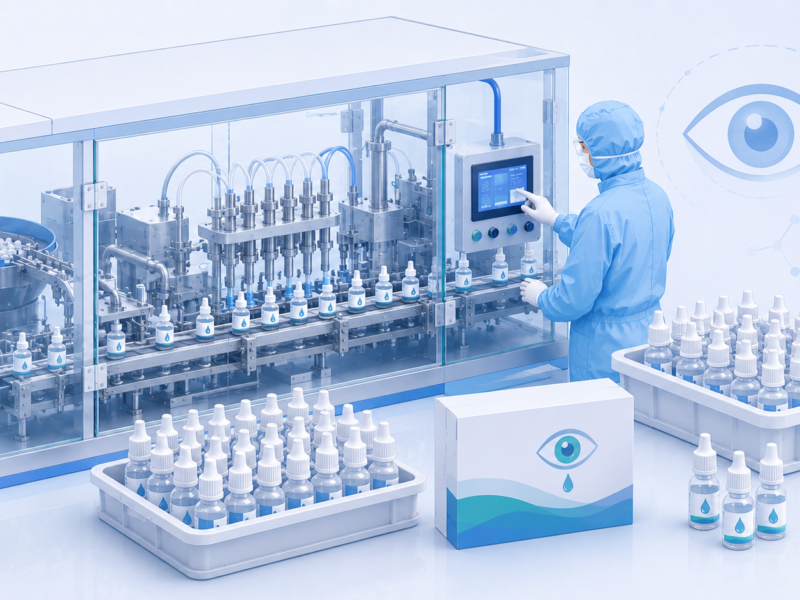
An eye drop looks like the simplest product on a pharmacy shelf, yet it is one of the hardest to make well. A sterile solution dosed into the eye leaves no room for a stray particle, a leaky cap or a batch that drifts out of spec. That is exactly why eye drops third party manufacturing appeals to so many brands: instead of building a cleanroom and validating an aseptic line, you hand the sterile work to a maker who already runs one. This guide explains what ophthalmic contract manufacturing actually involves — the bottle formats, preservative choices, fill process, order quantities and the checks that tell a serious ophthalmic maker apart from a hopeful one.
Key takeaways (TL;DR)
- Eye drops are sterile ophthalmic products — they need aseptic cleanrooms and validated fill, not a standard liquid line, so outsourcing usually beats building.
- The dropper bottle format you choose (LDPE squeeze, FFS, or preservative-free unit-dose) shapes cost, shelf life and how your brand looks on shelf.
- Preservative decisions are commercial as well as technical — multi-dose bottles carry a preservative; single-use vials let you go preservative-free.
- Ophthalmic MOQs run higher than tablets because of sterile changeover and validation; clarify per-SKU minimums up front.
- Vet an ophthalmic maker on aseptic capability, particle and sterility testing, and dropper-fill experience long before you discuss rate.
Why ophthalmics sit in a category of their own
Most contract manufacturing conversations start with tablets or syrups, where the bar is competence and consistency. Ophthalmics raise that bar sharply. A drop goes onto a surface that has almost no natural defence against contamination, so the finished product has to be sterile, free of visible and sub-visible particles, gentle on tissue, and stable in a tiny container that a patient squeezes dozens of times. None of that happens on a general liquid line. It needs a dedicated aseptic suite, filtration down to the sub-micron level, and a quality team that treats sterility as the headline spec rather than a box to tick. For a brand owner the practical takeaway is simple: an ophthalmic maker is not a syrup maker who also fills bottles. It is a different competence, and you should shortlist accordingly.
Dropper bottle and pack formats to choose from
The container is half the product decision. The format you pick affects unit cost, perceived quality, preservative needs and how patients dose. Here is how the common ophthalmic formats compare.
| Format | What it is | Best suited to |
|---|---|---|
| LDPE multi-dose dropper | Squeezable plastic bottle with nozzle and tamper cap, 5-10 ml | Most everyday drops; familiar, economical, preserved |
| FFS (Form-Fill-Seal) | Bottle formed, filled and sealed in one automated aseptic cycle | High-volume runs wanting tight contamination control |
| Preservative-free unit dose | Single-use sealed vials, no preservative | Sensitive-eye or frequent-use positioning; premium tier |
| Glass dropper bottle | Amber glass with separate dropper assembly | Light-sensitive or specialised formulations |
A single brand often runs more than one format — an economical multi-dose line for volume and a preservative-free range as a premium differentiator. Ask your maker which formats their line is validated for before you lock a roadmap.
Preservatives: a commercial decision, not just a chemical one
Every multi-dose bottle that gets opened and reused needs a way to stay safe between doses, which is why preserved formulations remain the workhorse of the category. But preservative choice has become a marketing axis as much as a formulation one. A growing slice of buyers actively look for preservative-free positioning, and that demand is what makes unit-dose vials a useful premium tier rather than a niche. From a brand-building view the trade-off is straightforward: preserved multi-dose bottles are cheaper to make and ship, while preservative-free formats cost more per unit but let you market to a segment willing to pay for it. There is no single right answer — the question is which positioning fits your range. A capable ophthalmic maker should be able to quote both and tell you honestly which formulations suit which route. We avoid clinical claims here on purpose; treat this as commercial guidance and confirm formulation specifics with your manufacturer.
How a sterile ophthalmic order moves
The sterile nature of the product adds steps you won’t see on an oral-liquid job. A typical flow looks like this.
- Brief and feasibility — share your molecules, format, volume and target pack; the maker confirms what their aseptic line can support.
- Quote and MOQ — net rates, per-SKU minimum order quantities and lead times for sterile changeover.
- Papers and brand — Drug License, GST and trademark or brand artwork details.
- Solution prep and sterile filtration — the bulk is compounded and filtered to remove micro-organisms.
- Aseptic fill and seal — dropper bottles or vials are filled and sealed inside the cleanroom.
- Sterility and particle testing — batch checks for sterility, clarity and particulate matter before release.
- Labelling and dispatch — tamper-evident packing, cartoning and shipment to you.
MOQs, packaging and what moves the price
Ophthalmic economics differ from oral solids in one key way: sterile changeover and validation are expensive to set up for each run, so minimum order quantities tend to be higher and the per-unit price is sensitive to how often the line is reconfigured. The drivers below shape almost every ophthalmic quote.
| Driver | Effect on your quote |
|---|---|
| Active molecule | Some ophthalmic actives cost far more than others; this sets the floor |
| Bottle format | FFS and unit-dose vials cost more than a standard LDPE dropper |
| Preservative route | Preservative-free unit-dose runs carry a higher per-unit price |
| Batch / MOQ | Larger sterile runs spread changeover cost and cut per-unit rate |
| Packaging detail | Nozzle type, tamper cap, carton, insert and outer all add up |
Every figure above is indicative. Work from a written quote tied to your exact SKUs, format and volumes before you commit.
Documents and brand inputs to have ready
- Drug License (wholesale or manufacturing, as applicable to your role)
- GST registration
- Brand name and trademark / artwork details
- A product list naming each molecule, strength, fill volume and bottle format
- Any preservative-free or pack preferences you want quoted separately
How to vet an ophthalmic manufacturer
With sterile products the cheapest quote is the wrong place to start. Run any shortlist through these checks first.
- Aseptic capability — a dedicated, validated sterile suite, not a shared liquid line.
- Dropper-fill track record — proven experience filling ophthalmic bottles and vials, not just other sterile forms.
- Testing rigour — in-house sterility, clarity and particulate-matter testing with documented release.
- Format range — can they cover both preserved multi-dose and preservative-free unit dose as you grow?
- Certifications and supply — WHO-GMP, ISO and Schedule M compliance plus reliable, repeatable dispatch.
Biozia Lifesciences manufactures eye drops as one of its nine dosage forms, with real ophthalmic products such as Olopatadine and Moxifloxacin combination drops already in its range. WHO-GMP and ISO certified, based in Yamunanagar, Haryana with pan-India supply, and led by a team carrying 40+ years in pharma, Biozia pairs the sterile and injectable strength many makers lack with the ophthalmic fill experience this category demands.
Planning an eye drop range under your own brand? Request a manufacturing quote from Biozia Lifesciences →
Related guides
- Third-Party Pharma Manufacturing in India
- Dry Syrup Third-Party Manufacturing in India
- Syrup & Suspension Third-Party Manufacturing
- Tablet Third-Party Manufacturing in India
Frequently asked questions
Can I get eye drops made under my own brand without a factory?
Yes. In third-party ophthalmic manufacturing the maker produces sterile drops on their own certified aseptic line while you keep the brand, artwork and distribution. It is the standard route for brands that want eye drops without funding a cleanroom.
Should I choose preserved bottles or preservative-free vials?
It is mainly a commercial call. Preserved multi-dose bottles are cheaper to make and the category mainstay; preservative-free unit-dose vials cost more but let you target buyers who prefer them. Many brands run both. Confirm formulation specifics with your manufacturer.
Why are eye drop MOQs higher than for tablets?
Sterile production needs cleanroom changeover and validation that is costly to set up per run, so makers set higher minimum order quantities to keep the per-unit rate workable. Ask for per-SKU minimums up front.
What bottle formats can be manufactured?
Common options are LDPE squeeze droppers, Form-Fill-Seal bottles, preservative-free single-use vials and amber glass dropper bottles. The right one depends on volume, positioning and the formulation; a capable maker will advise which their line is validated to fill.
What should I check before signing with an ophthalmic maker?
Confirm a dedicated validated aseptic suite, documented sterility and particulate testing, genuine dropper-fill experience, and WHO-GMP, ISO and Schedule M compliance. Compare price only after capability and quality evidence pass.
Author: Biozia Lifesciences Editorial Team — insights drawn from Biozia Lifesciences’ WHO-GMP & ISO-certified manufacturing and PCD franchise operations in India, led by 40+ years of industry experience. This article is general business information and not medical or legal advice.
Interested in a Biozia PCD Franchise?
Get monopoly rights, a wide product range and full marketing support in your territory.