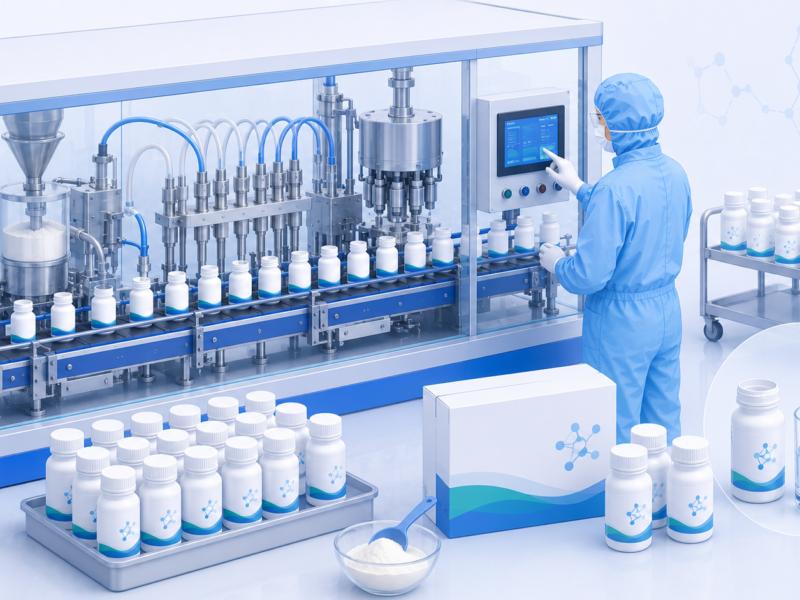
If your range leans toward pediatric drops or antibiotic courses, sooner or later you will need a powder that the chemist or parent mixes with water before the first dose. That is exactly what dry syrup third party manufacturing delivers: a licensed maker blends and fills a stable powder under your brand, and it only becomes a liquid at the point of use. The catch is that this form behaves nothing like a ready-made syrup — moisture, fill weight and the bottle itself decide whether it survives a monsoon shelf. This guide covers how the powder is built, how stability is protected, and what you sign off before a batch ships.
Key takeaways (TL;DR)
- A dry syrup is a measured powder or granule shipped dry and reconstituted with water before use — the most common home for many pediatric and antibiotic suspensions.
- The whole form lives or dies on moisture control: dry processing rooms, low-humidity filling and a tight-sealing closure matter more than almost anything else.
- Pack-size economics run on bottle volume and reconstituted shelf life, not a single per-bottle rate.
- You will need a Drug License, GST and brand artwork that carries the reconstitution and post-mixing storage instructions clearly.
- Vet the maker on humidity-controlled granulation, fill-weight accuracy and amber-bottle supply before you compare quotes.
What a dry syrup actually is — and why brands choose it
A dry syrup, sometimes called a powder for oral suspension, is a dry blend dosed into a bottle and reconstituted with purified or boiled-cooled water just before use. The reason brands pick it over a ready liquid is shelf life. Many molecules — a large share of pediatric antibiotics among them — are simply not stable sitting in water for two years. Keep them dry and the usable life stretches across a full distribution chain; add water only at dispensing and the active has to survive just the short course in the patient’s hands. For a B2B brand that ships across India’s heat and humidity, that dry window is the entire commercial advantage.
How the powder is built, step by step
Dry syrups are made on standard GMP oral lines, but the room conditions are tighter than for tablets or ready syrups. The flow a contract maker follows looks like this:
1. Sifting and dry blending
The active is sifted with sugar or a sugar-free base, suspending agents, a buffer, sweeteners and flavour, then blended to a uniform powder so every spoonful after mixing carries the same strength.
2. Granulation, where needed
Some formulations are granulated to improve flow and stop the powder caking in the bottle. Where a molecule is moisture-sensitive, dry granulation is preferred so no water is introduced during processing.
3. Filling by weight
The blend is filled into bottles to a target weight that leaves the correct headspace for water. Fill-weight accuracy is critical — it sets the final concentration once the bottle is topped up to the mark.
4. Sealing and packing
Bottles get an induction or wad seal, a measuring cup or dropper, the carton, insert and a batch-coded label before going to quality control for release.
Moisture and stability: the part that decides everything
This is where dry syrups separate a careful manufacturer from a careless one. Because the active is supposed to stay dry until the patient adds water, any moisture picked up during processing, filling or storage starts the clock early — you can see it as caking, colour change or potency loss. A serious maker controls relative humidity in the granulation and filling rooms, validates the closure so the seal genuinely keeps damp air out, and runs accelerated and real-time stability studies to fix both the dry shelf life and the much shorter “use within X days of reconstitution” window that has to print on your label. When you brief a contract maker, ask specifically how they hold humidity during filling and what their stability data shows; vague answers here are a red flag for this form in particular.
Packaging and pack sizes
Bottle choice is a stability decision, not just a branding one. The format and headspace are part of how the product stays dry and how accurately the end user can reconstitute it.
| Element | Typical choice | Why it matters |
|---|---|---|
| Bottle | Amber PET or glass, 30-100 ml | Amber shields light-sensitive actives; sizing leaves headspace for water |
| Closure | Induction/wad-sealed cap | Keeps humidity out until first opening |
| Reconstitution mark | Moulded or printed fill line | Lets the user top up to the exact concentration |
| Dosing aid | Measuring cup or dropper | Accurate per-dose volume after mixing |
| Secondary pack | Carton + insert | Carries reconstitution and post-mixing storage instructions |
MOQ, cost drivers and documents
Minimum order quantities for dry syrups are usually quoted per batch, and the batch size is tied to bottle volume and the molecule. There is no single per-bottle number worth chasing; what moves your quote is the combination below.
| Driver | How it moves your quote |
|---|---|
| Active molecule | Antibiotic actives in particular swing the cost; some are far dearer than the base |
| Bottle volume | 30 ml versus 100 ml changes fill weight, bottle and carton cost |
| Batch / MOQ | Larger runs spread set-up and cut the per-bottle price |
| Flavour & base | Sugar-free or premium flavours add to the blend cost |
| Packing spec | Glass over PET, droppers, or export-grade artwork raise the rate |
Treat every figure as indicative until you have a written quote for your exact molecules, bottle sizes and batch quantities.
The paperwork to get started is the same backbone as any contract pharma order:
- Drug License (wholesale or manufacturing, as applicable to your set-up)
- GST registration
- Brand name and trademark details
- A product list naming each molecule, the bottle size and the flavour you want
Sourcing dry syrups from Biozia Lifesciences
Biozia Lifesciences makes dry syrups as part of a range spanning nine dosage forms — from oral solids and liquids through to the sterile injections, IV infusions and eye drops many makers cannot offer. WHO-GMP and ISO certified and based in Yamunanagar, Haryana, with pan-India supply and a leadership team carrying 40+ years in pharma, it is set up to manage the humidity-controlled processing and bottle packaging this form depends on, and to grow a pediatric or antibiotic range across other forms as your brand scales.
Have a dry syrup range in mind? Request a manufacturing quote from Biozia Lifesciences →
Related guides
- Third-Party Pharma Manufacturing in India
- Syrup & Suspension Third-Party Manufacturing
- Tablet Third-Party Manufacturing in India
- Capsule Third-Party Manufacturing in India
Frequently asked questions
What is the difference between a dry syrup and a regular syrup?
A regular syrup ships as a finished liquid; a dry syrup ships as a powder that the chemist or end user mixes with water before the first dose. The dry form is chosen when the active cannot stay stable in water for the full shelf life, which is common with many pediatric and antibiotic products.
Why does moisture control matter so much for dry syrups?
The product is meant to stay dry until water is added at use. Any moisture absorbed during processing, filling or storage can cause caking, colour change or loss of potency, so humidity-controlled rooms and a tight-sealing closure are central to making this form well.
What bottle sizes are typical for third-party dry syrups?
Amber PET or glass bottles in roughly the 30 to 100 ml range are common, with a moulded or printed fill line so the user can top up to the right concentration. The exact size is fixed by your molecule and target course.
How is the MOQ for a dry syrup decided?
It is usually quoted per batch and depends on the molecule and the bottle volume. Larger batches spread the set-up cost and lower the per-bottle price, so it is worth discussing your expected volumes when you ask for a quote.
What documents do I need to start a dry syrup order?
A Drug License and GST registration are the essentials, along with your brand or trademark details and a product list naming each molecule, the bottle size and the flavour you want.
Author: Biozia Lifesciences Editorial Team — insights drawn from Biozia Lifesciences’ WHO-GMP & ISO-certified manufacturing and PCD franchise operations in India, led by 40+ years of industry experience. This article is general business information and not medical or legal advice.
Interested in a Biozia PCD Franchise?
Get monopoly rights, a wide product range and full marketing support in your territory.