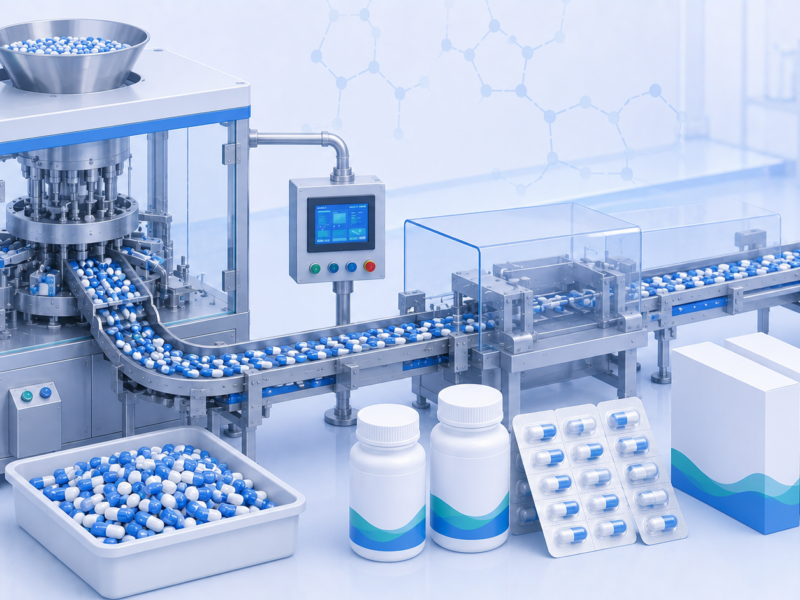
If your range needs capsules — an antibiotic, a multivitamin, a probiotic, an omega blend — you rarely need to own a filling line to sell them under your own label. Capsule third party manufacturing lets a licensed maker fill, polish and pack the shells to your formula while you keep the brand and the market. But a capsule is not just “a tablet in a shell”: the shell material, the fill type and the packaging each change what’s possible and what it costs. This guide is written specifically for capsules — what you can fill, when a capsule beats a tablet, and how to brief a maker so the first batch lands right.
Key takeaways (TL;DR)
- Hard-gelatin capsules dominate outsourced work; softgels are a separate, more specialised line you’ll usually source from a dedicated maker.
- The fill matters as much as the shell — plain powder, granules, or coated pellets for sustained or delayed release all change tooling and price.
- Capsules win when a drug tastes bad, needs to mask odour, combines pellets, or is hard to compress into a stable tablet.
- Blister or Alu-Alu packing protects moisture-sensitive fills; bottles suit large-count nutraceutical lines.
- A Drug License and GST start you off; MOQ, shell colour and packaging decide your first capsule order.
Hard gelatin, softgel and the veg alternative
Before you ask for a quote, know which capsule you actually mean — they’re made on different equipment and the gap matters when you shortlist a maker.
| Shell type | Best for | Notes for sourcing |
|---|---|---|
| Hard gelatin (two-piece) | Powders, granules, pellets, small tablets | The workhorse; widest contract availability |
| HPMC / vegetarian | Same fills, plant-based market | Suits vegan and certain export buyers |
| Softgel (one-piece) | Oils, omega-3, vitamin E, liquid blends | Specialised encapsulation; fewer makers |
Most third-party capsule work is two-piece hard capsules. Softgels — the sealed, oil-filled type — need their own encapsulation plant, so if your product is an oily nutraceutical, ask up front whether the maker runs softgel lines or only hard capsules.
Powder fill vs pellet fill
What goes inside the shell is the part buyers skip over, yet it drives both the cost and what the product can claim to do. There are three common fills:
- Plain powder — the simplest and cheapest; the blended active and excipients are dosed straight into the shell.
- Granules — powder that’s been granulated for better flow and content uniformity, useful for higher-dose or sticky blends.
- Pellets — tiny coated spheres that can give sustained-release or delayed (enteric) behaviour, and let you combine two actives that shouldn’t touch in one capsule.
Pellet filling is where capsules quietly outshine tablets: a single capsule can hold pellets coated for different release times, something that’s far harder to engineer in a compressed tablet. If your formula calls for modified release, say so early — it changes the tooling, the testing and the lead time.
When a capsule beats a tablet
Capsules and tablets are not interchangeable. Reach for a capsule when:
- The active tastes bitter or smells unpleasant — the shell masks both without a coating step.
- The molecule is hard to compress or unstable under tablet pressure — a capsule skips compaction entirely.
- You want a clean, premium look for a nutraceutical or probiotic line, or a transparent shell to show pellets.
- You need a pellet-in-capsule release profile, or two actives kept apart until they’re swallowed.
Tablets still win on the lowest per-unit cost at very high volumes and on scored or chewable formats. For everything taste-sensitive, pressure-sensitive or pellet-based, the capsule is usually the better contract choice.
Packaging your capsules
Gelatin is sensitive to moisture, so packaging isn’t an afterthought — it protects shelf life. Match the pack to the product:
| Pack format | Good for | Trade-off |
|---|---|---|
| PVC/PVDC blister | Pharma capsules, unit-dose strips | Standard, economical |
| Alu-Alu blister | Moisture/light-sensitive fills, pellets | Higher cost, best protection |
| HDPE bottle | High-count nutraceutical/multivitamin | Needs desiccant; less unit-dose control |
For sensitive or enteric-coated pellet capsules, Alu-Alu earns its higher cost. For large bottle counts of a supplement, factor in a desiccant. Decide format before artwork — the carton and insert size depend on it.
MOQs and the documents to start
Two questions decide your first order: how much you must commit to (the MOQ) and what paperwork lets the maker produce under your brand.
Minimum order quantity
MOQs move with the fill and packaging, not just the capsule count. A plain-powder hard capsule in standard blister usually carries a lower MOQ than a coated-pellet, Alu-Alu-packed line, because pellet coating and special tooling need a viable batch to be economical. Custom shell colours or printed shells can lift the minimum too. Always ask for the MOQ alongside the per-unit rate — one without the other tells you little.
Documents you’ll need
- Drug License (wholesale or manufacturing, as applicable to your role)
- GST registration
- Brand name and trademark details for the shell, blister foil and carton
- A product brief: actives, strengths, fill type (powder/pellet), shell preference and pack format
Why source capsules from Biozia Lifesciences
Biozia Lifesciences is a WHO-GMP and ISO-certified manufacturer in Yamunanagar, Haryana, producing capsules among 250+ formulations across nine dosage forms — from oral solids to sterile injections, IV infusions and eye drops. Founded in 2025 and led by Chairman Anil Kumar Goel’s 40+ years in pharma, Biozia gives capsule buyers a single partner who can also grow the range across tablets, syrups and sterile lines as you scale, with dependable pan-India supply.
Have a capsule formula or brand in mind? Request a manufacturing quote from Biozia Lifesciences →
Related guides
- Third-Party Pharma Manufacturing in India
- Herbal & Ayurvedic Third-Party Manufacturing
- Injectable Third-Party Manufacturing in India
- IV Infusion & Fluid Third-Party Manufacturing
Frequently asked questions
What’s the difference between hard gelatin and softgel capsules for outsourcing?
Hard gelatin (two-piece) capsules are filled with powders, granules or pellets and are the most widely available contract format. Softgels are one-piece sealed shells made for oils and liquids on a separate, more specialised line. If your product is oil-based, confirm the maker actually runs softgel encapsulation.
Can I get sustained-release capsules made on contract?
Yes — sustained or delayed release is typically achieved with coated pellets filled into the capsule. Mention the release profile in your brief, as pellet coating changes the tooling, testing and lead time compared with a plain-powder capsule.
Why choose a capsule over a tablet?
Capsules mask bitter taste and odour, suit actives that are hard to compress or unstable under tablet pressure, give a premium look, and can hold pellets for modified release or keep two actives apart. Tablets stay cheaper at very high volume and for scored or chewable formats.
What MOQ should I expect for capsules?
It varies with the fill and packaging. A plain-powder capsule in standard blister usually has a lower minimum than a coated-pellet line in Alu-Alu, and custom or printed shells can raise it. Ask for the MOQ together with the per-unit rate; figures are indicative until you have a written quote.
What documents do I need to start a capsule order?
A Drug License and GST registration are essential, plus your brand or trademark details for the shell, foil and carton, and a product brief covering the actives, strengths, fill type, shell preference and pack format.
Author: Biozia Lifesciences Editorial Team — insights drawn from Biozia Lifesciences’ WHO-GMP & ISO-certified manufacturing and PCD franchise operations in India, led by 40+ years of industry experience. This article is general business information and not medical or legal advice.
Interested in a Biozia PCD Franchise?
Get monopoly rights, a wide product range and full marketing support in your territory.