Reviewed by Anil Kumar Goel, B.Pharm — Chairman, Biozia Lifesciences, 40+ years in the pharmaceutical industry.
A derma PCD pharma franchise lets you market a dermatology range under your own territory rights without setting up a factory. The model works well because skin conditions bring patients back to the same dermatologist and chemist, but it only pays off if the products, the manufacturer and your own field plan are right. This guide covers how the process works, what you need in place, how the cost structure is built, how to judge a partner, and the mistakes that most often hurt new derma distributors in India.
Key takeaways (TL;DR)
- A derma PCD franchise gives you exclusive marketing rights for a topical and oral dermatology range in your district or state, supplied by a licensed manufacturer.
- You need a drug licence (wholesale or retail, as applicable), GST registration and basic ID and address proof before you can stock and sell.
- Costs are mainly the first stock order, promotional inputs, field staff and logistics. Ask for every item in writing instead of relying on a single headline figure.
- Most derma products are prescription medicines, so the doctor-facing work matters more than chemist push.
- Judge a partner on manufacturing licence, WHO-GMP status, batch quality, supply reliability, range depth and written territory terms.
- Be careful with steroid-containing combinations: check composition and regulatory status, and promote them for prescription use only.
What a derma PCD pharma franchise actually is
In a PCD (Propaganda cum Distribution) arrangement, the manufacturer produces and supplies the medicines, and you promote and distribute them in an agreed area. In dermatology, the range usually covers antifungal and antibacterial creams, steroid combinations, depigmenting agents, anti-scabies preparations and a few oral antifungals.
Dermatology suits this model for practical reasons. Many skin conditions are chronic or recurring, prescribing is concentrated among dermatologists, general physicians and paediatricians, and fungal infections tend to rise in hot, humid months. The same doctors can be revisited with new products across seasons.
With monopoly rights, the company does not appoint another distributor for the same brands in your territory. Get the exact scope in writing: which brands, which districts, and for how long.
Next step: decide your territory and the doctor segments you can realistically cover in the first six months before you talk to any manufacturer.
How the process works, step by step
The sequence is similar across most companies, though paperwork speed differs.
- Enquiry and territory check: the company confirms your area is open for the brands you want.
- Range selection: you pick the products that match the doctors you will visit.
- Documentation: licence, GST and identity papers are submitted and verified.
- Agreement: terms on exclusivity, minimum commitment, pricing, returns and duration are signed.
- First order and dispatch: stock is manufactured or released from available batches and shipped with invoices and batch details.
- Promotion: you begin doctor visits using visual aids, product literature and samples as supplied.
Ask for a draft agreement early. A genuine company will share it before you pay anything.
Next step: prepare a one-page plan listing target doctors, expected number of visits per month and the products you will lead with.

Requirements: licences and documents you need
To buy, store and sell medicines you need a valid drug licence issued by your State Drug Controller. This is usually a wholesale licence if you will supply chemists and stockists, and the exact licence type depends on how you plan to operate. You also need GST registration, a PAN, address proof for your premises and standard identity documents. A clean, dry storage space is needed too, since creams and ointments should be kept as per label storage conditions.
Requirements can vary slightly by state and by company, so confirm the list with your partner. A fuller checklist is in our guide on documents required for a PCD pharma franchise.
Next step: if your licence is not ready, start that application first. It is often the slowest part of the whole process.
Cost structure of a derma PCD franchise
There is no single correct figure, and any company promising a fixed cost without knowing your territory should be questioned. Instead, understand the components so you can compare offers on the same basis.
- Initial stock order: the largest outlay. Ask whether a minimum order applies and how it is spread across brands.
- Licence and compliance: government fees and professional help for the drug licence and GST setup.
- Promotional inputs: visual aids, literature, doctor samples and any gift or conference support. Clarify what the company supplies free and what you pay for.
- Field team: medical representative salaries, travel and incentives, if you appoint them.
- Logistics and storage: freight, handling, and storage space.
- Credit and returns: payment terms, expiry and breakage policy, which directly affect your working capital.
Your earnings come from the margin between the price you buy at and the price you sell at. Margins differ by brand, so compare the net working-capital cycle, not just the percentage. For a fuller breakdown, see our guide to PCD pharma franchise investment and profit margin.
Next step: request a written price list with trade terms, then build your own month-by-month cash plan.
Choosing the right derma products
A derma portfolio should cover the conditions your doctors see most often, without overlapping brands that compete with each other. Biozia’s dermatology-related range includes the following, as per our product data.
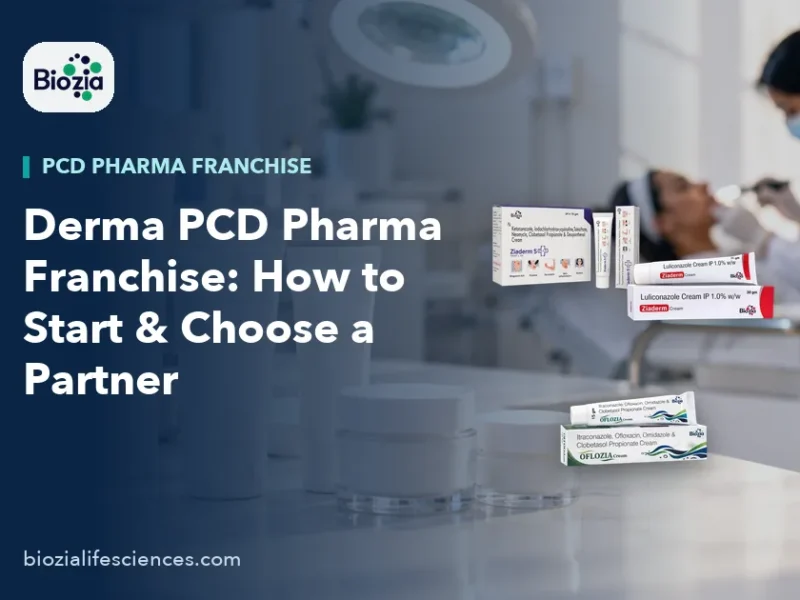
- Ziaderm Cream (Luliconazole 1.0% w/w, 30 gm): a topical azole antifungal for tinea infections such as ringworm, athlete’s foot and jock itch, and for tinea versicolor.
- Ziaderm 5 Plus Cream (antifungal, antibacterial and clobetasol combination, 15 gm): for mixed infected dermatoses, prescription only and for short, supervised use.
- Oflozia Cream (Ofloxacin 0.75% + Ornidazole 2.0% + Itraconazole 1% + Clobetasol 0.05%, 15 gm): for mixed bacterial and fungal skin infections with inflammation, prescription only.
- Muprozia Ointment (Mupirocin 2% w/w, 5 gm): a topical antibiotic for impetigo and other susceptible bacterial skin infections.
- Glowzia-HC Cream (Hydroquinone 2% + Tretinoin 0.025% + Mometasone Furoate 0.1%, 15 gm): for melasma and post-inflammatory hyperpigmentation under dermatological supervision.
- Scazia Lotion (Permethrin 5% w/w, 50 ml): for scabies and head or pubic lice, with household contacts treated as the doctor advises.
- Zia-IT 200 Capsule (Itraconazole 200 mg, 10×10 Alu/Alu): an oral triazole antifungal for conditions such as onychomycosis and dermatophytosis, as prescribed.
This mix lets a representative discuss fungal, bacterial, pigmentary and parasitic conditions in one visit. Several of these contain potent steroids or other prescription-only actives, so all promotion must stay with doctors and registered pharmacists, and doses and duration must follow the doctor’s prescription.
Next step: match each product to a doctor group (dermatologists, GPs, paediatricians) and decide which two or three you will lead with.

How to evaluate a derma PCD partner
Check the manufacturer, not just the brand name. Look at these points.
- Licences and certification: ask for the manufacturing licence and verify it. Biozia is a WHO-GMP and ISO certified company in Yamunanagar, Haryana, and you can read more on what WHO-GMP certification means for buyers.
- Composition and regulatory status: for every fixed-dose combination, confirm it is permitted in India and that the label carries the correct prescription warnings.
- Batch quality: ask for certificates of analysis and check that packaging, tube sealing and labelling are consistent.
- Supply reliability: ask about lead times and how repeat orders are handled.
- Territory terms: exclusivity, duration and what happens if you miss a target should all be written down.
- Support: visual aids, literature and a point of contact who answers quickly.
Next step: visit the plant or request a virtual walkthrough, and compare at least two companies against this list.
To discuss territory availability for the Biozia range, you can contact our team.
Common mistakes new derma distributors make
- Promoting steroid combinations as general remedies. Potent topical steroids can thin the skin and mask infections when overused. Position them only as prescription products for short, supervised use.
- Skipping the agreement. Verbal assurances on exclusivity or returns are hard to enforce later.
- Over-stocking early. Start with fast-moving brands and expand once you see prescriptions.
- Ignoring expiry dates. Topicals have limited shelf life, so track batches and clear slow stock early.
- Choosing only on margin. A high margin on a product doctors do not prescribe means unsold stock.
- Neglecting doctor follow-up. One visit rarely creates a prescriber. Plan repeat calls.
Next step: write your own checklist from this list and review it before placing your first order.
Interested in a derma PCD franchise for your territory? Enquire with Biozia Lifesciences →
Related guides
- Monopoly Rights in PCD Pharma Franchise Explained
- Documents Required for a PCD Pharma Franchise
- PCD Pharma Franchise Investment & Profit Margin
Frequently asked questions
Do I need a drug licence to start a derma PCD pharma franchise?
Yes. To purchase, store and sell medicines you need a valid drug licence from your State Drug Controller, along with GST registration. The licence type depends on whether you will supply chemists and stockists or sell retail. Confirm the exact requirement with your state drug authority and your partner company before ordering stock.
Are derma products under PCD franchise prescription-only?
Many are. Combinations containing potent corticosteroids, retinoids or antibiotics should be promoted only to doctors and sold against a prescription. Some simpler products may be available differently, but the label and prescribing status of each product should be checked. Never encourage self-medication with steroid-containing creams.
How much investment is needed for a derma PCD franchise?
It depends on the company, territory and range, so no honest single figure applies to everyone. Costs mainly include the first stock order, licence and compliance, promotional material, field staff and logistics. Ask each company for a written breakdown and compare offers on that basis.
What does monopoly rights mean in a derma PCD franchise?
It means the company supplies its listed brands to only you in an agreed territory, so no other distributor sells the same brands there. The scope, brands, area and duration should be stated clearly in the agreement. Verify whether exclusivity depends on minimum order commitments.
Can I get a derma range made under my own brand instead?
Yes. If you want your own brand name, third-party (contract) manufacturing is the alternative. The manufacturer produces the range to your formulation choices and your packaging, and you own the marketing. It needs more planning, including brand registration and minimum batch quantities, so compare it with a PCD franchise before deciding.
This article is general business information for pharma distributors and brand owners. Licensing rules and costs change; confirm current requirements with your State Drug Controller or a qualified consultant before acting.
Interested in a Biozia PCD Franchise?
Get monopoly rights, a wide product range and full marketing support in your territory.