Reviewed by Anil Kumar Goel, B.Pharm — Chairman, Biozia Lifesciences, 40+ years in the pharmaceutical industry.
A PCD pharma franchise in Delhi works differently from one in a small district town. Prescribers are dense, chemists are well organised, and many brands compete for the same doctor’s attention. Delhi also sits next to Gurugram, Noida, Ghaziabad and Faridabad, which fall under different state drug authorities. This guide covers what a Delhi franchise partner needs to know: demand, licensing, logistics from our plant in Yamunanagar, cost heads, how to evaluate a company, and mistakes to avoid.
Key takeaways (TL;DR)
- Delhi is a high-prescriber, high-competition market. Success depends on a focused product list and regular doctor and chemist coverage, not on the number of products.
- Wholesale activity in Delhi is licensed by the state Drugs Control Department. Confirm with your partner company which licences you need for your billing model.
- Delhi NCR towns such as Gurugram, Noida and Ghaziabad are under Haryana and Uttar Pradesh authorities. Licensing and territory rights must be defined clearly.
- Supply from Yamunanagar reaches Delhi by road, so agree dispatch frequency, transit responsibility and breakage or damage terms in writing.
- Judge a partner on manufacturing certifications, written monopoly terms, batch documents and product fit for your doctors, not on promised margins.
Why Delhi needs a different approach
Delhi has a large number of hospitals, nursing homes, polyclinics and individual practitioners across both the main city and its colonies. Chemists are also dense, and many buy in small, frequent lots from established wholesale markets. For a PCD franchise this means two things. Doctors are already visited by many representatives, so a new brand needs a clear reason to be prescribed. Chemist shelves are limited, so slow-moving products get dropped quickly.
Seasonal patterns matter as well. Air quality and weather changes in the region influence allergy, respiratory and eye complaints, and these shape which therapy segments move at different times of the year. Plan your product mix and stock for those cycles instead of ordering the whole catalogue at once.
Next step: before signing, list the 30 to 50 doctors and 20 to 30 chemists you can realistically reach in the first three months, and note their specialities. Choose a franchise range that fits that list.
Licensing and documents for a Delhi franchise
In India, the company holds the manufacturing licence and the product approvals. Where the franchise partner buys stock and sells it on to chemists or stockists, that activity is generally treated as wholesale. In Delhi, wholesale drug licences are issued by the Drugs Control Department of the Delhi government, which acts as the State Drug Controller. Under the Drugs and Cosmetics Rules, wholesale licences are the 20B and 21B forms, depending on the categories of drugs.
Typical requirements, which you should verify with the department and your own consultant, include:
- Proof of premises (ownership or rent agreement) suitable for storing medicines.
- A registered pharmacist or other competent person for the wholesale licence.
- GST registration and PAN, along with identity and address proof.
- Basic storage arrangements such as racks, a clean dry area and, if you plan to handle temperature-sensitive products, suitable cold storage.
Some franchise companies handle billing and dispatch themselves, which can change what you need on your side. Ask your partner exactly which model applies to you, and who raises the invoice to the chemist. Our separate note on documents required for a PCD pharma franchise lists what companies usually ask for at onboarding.
One Delhi-specific point: a Delhi licence does not cover sales to a chemist or hospital in Gurugram, Faridabad, Noida or Ghaziabad if you are expected to hold stock or bill from there. Decide early whether your territory is Delhi only or the wider NCR, and check licensing for each state.
Next step: contact the Delhi Drugs Control Department or a local licensing consultant, confirm which licence your billing model needs, and ask your partner company to confirm in writing what they will and will not supply on their side.
Logistics from Yamunanagar to Delhi
Biozia manufactures in Yamunanagar, Haryana, and the road link towards Delhi runs through the Haryana belt. Stock normally travels by road transport or courier depending on quantity. Because the route is short compared with dispatch to the south or east, small repeat orders are practical, which suits Delhi’s pattern of frequent smaller purchases by chemists.
Even so, agree these points before you place the first order:
- Dispatch cycle: how soon after order confirmation the consignment leaves the plant.
- Transit risk: who bears loss or breakage, particularly for glass ampoules and eye drops.
- Documents: invoice, e-way bill where applicable, and batch details travelling with every consignment.
- Minimum order: ask for the exact terms in writing instead of relying on a verbal quote.
- Returns: how near-expiry stock and damaged goods are handled.
For regional context, our pages on PCD pharma franchise in Haryana and Yamunanagar explain how we support territories close to the plant.
Next step: ask for a sample dispatch plan for your first order, covering quantities by product, packing method and expected delivery time to your Delhi address.

Cost structure and how to evaluate a partner
Instead of chasing a single investment figure, look at the cost heads you will carry. The real number depends on your territory, team size and how quickly you scale. Our page on PCD franchise investment and profit margin explains how to build this estimate.
- Licence, GST and professional fees for compliance.
- Initial stock of the products you choose.
- Storage space, racks and basic stock software or registers.
- Medical representatives or your own field time, plus travel within Delhi.
- Promotional material such as visual aids, samples and literature, where the company provides them or where you must buy them.
- Working capital to cover credit given to chemists.
Evaluate the company on facts you can check:
- Manufacturing licence, and WHO-GMP and ISO certificates that match the plant that will actually make your products. Read what WHO-GMP certification means before you rely on a logo.
- Written monopoly terms for your territory. See monopoly rights in PCD pharma franchise for what to look for in an agreement.
- Willingness to share batch numbers, COAs and product permission details.
- Clear policy on expiry, replacement and what happens if a product is withdrawn.
- A product list that matches your prescribers instead of a catalogue of everything the company makes.
Next step: build a simple sheet with each cost head and your estimated monthly spend, then ask each shortlisted company to fill in its side of the terms in writing so you can compare.
Choosing products that fit Delhi prescribers
Start with therapy areas where you already have doctor contacts. A few examples from the Biozia range show how this works. All are prescription or doctor-guided products and should be promoted accordingly.
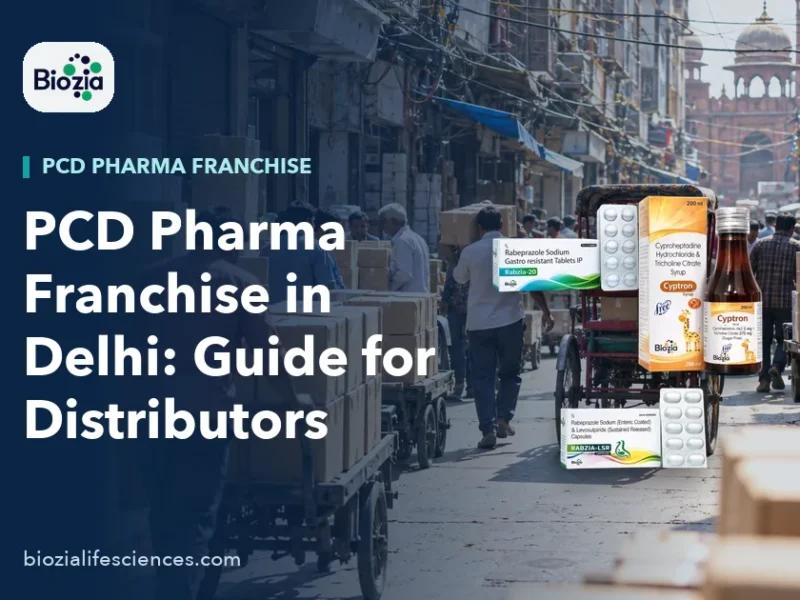
- Gastroenterology and general practice: Rabzia-20 Tablet (Rabeprazole 20 mg, 10×10 Alu/Alu) is a proton pump inhibitor used in acid-related conditions. Rabzia-LSR Capsule combines enteric coated Rabeprazole 20 mg with Levosulpiride 75 mg (sustained release) for reflux with motility problems, as prescribed by a doctor.
- Physicians and neurology or diabetes clinics: Cob-V 1500 Injection (Methylcobalamin 1500 mcg, 2ml Amp & Dispo Pack) is used for vitamin B12 deficiency and neuropathic conditions under medical supervision.
- Ophthalmology: Visiquin Eye Drop (Moxifloxacin 0.5% w/v, 5ml) is a topical antibiotic for bacterial eye infections, prescribed by an eye doctor.
- Paediatrics and general practice: Cyptron Syrup (S/F) combines Cyproheptadine HCl 2 mg and Tricholine Citrate 275 mg, used as an appetite stimulant and antihistamine under medical advice.
Do not try to cover all segments at once in Delhi. A tight set of five to ten products you can explain well usually works better than a long list that no representative can present properly.
Next step: match each product to a speciality on your doctor list, ask the company for the product permissions and visual aids, and start with the segments where you can make repeat visits.

Common mistakes Delhi franchise partners make
- Assuming a Delhi licence or franchise agreement automatically covers Gurugram, Noida, Ghaziabad or Faridabad.
- Taking too many products and spreading the field team thin across specialities.
- Accepting a verbal monopoly promise without written territory boundaries, sub-area definitions and a notice period.
- Overstocking in the first order and then carrying near-expiry stock.
- Giving long credit to new chemists without a limit or follow-up system.
- Promoting prescription products to the public or telling patients to self-medicate, which is both a legal and an ethical problem.
- Skipping a visit to the plant or a document check before committing.
Next step: write down which of these risks applies to you and discuss each one with the company before signing. If you want to see the range or discuss terms for Delhi, use the form below to ask for the product list and agreement terms.
Interested in a PCD pharma franchise in Delhi? Enquire with Biozia Lifesciences →
Related guides
- PCD Pharma Franchise in Haryana
- PCD Pharma Franchise Investment & Profit Margin
- How to Start a PCD Pharma Franchise in India
Frequently asked questions
Do I need a drug licence to start a PCD pharma franchise in Delhi?
It depends on the billing model. If you buy stock and sell it on to chemists or stockists, that is wholesale activity and needs a wholesale drug licence from the Delhi Drugs Control Department. If the company bills directly and you only promote, requirements can differ. Ask your partner to state the model in writing and confirm with the department.
Can I get monopoly rights for all of Delhi?
Many companies offer territory-based monopoly rights, but the area, products and duration must be written in the agreement. Delhi is large, so some companies split it by district or zone. Ask whether the rights apply to the whole of Delhi, only part of it, or the wider NCR, and what conditions apply.
How long does it take for stock to reach Delhi from Yamunanagar?
Delivery is by road, so transit is short, but the exact time depends on dispatch preparation, the transporter and the order size. Ask the company for its dispatch cycle and typical delivery time to your address. Also agree who is responsible for loss or damage in transit.
Which products sell best in Delhi?
There is no single answer, because it depends on your doctors and chemists. General practice, gastro, eye care, paediatric and vitamin segments are commonly built in cities. Choose products where you can explain composition and positioning to prescribers, and start small before you widen the range.
Is a franchise in Delhi NCR towns under the same licence?
Not necessarily. Gurugram and Faridabad come under Haryana authorities, and Noida and Ghaziabad under Uttar Pradesh. A licence issued in one state does not automatically cover stock held or billed in another. Decide your exact territory and check licensing for each location before you start.
How do I check that a PCD company is genuine?
Ask for the manufacturing licence, WHO-GMP and ISO certificates, product permissions and sample batch documents. Check that the manufacturing address on these matches the plant that supplies you. Verify the franchise agreement, visit the facility if possible, and avoid companies that talk only about margins without documents.
This article is general business information for pharma distributors and brand owners. Licensing rules and costs change; confirm current requirements with your State Drug Controller or a qualified consultant before acting.
Interested in a Biozia PCD Franchise?
Get monopoly rights, a wide product range and full marketing support in your territory.