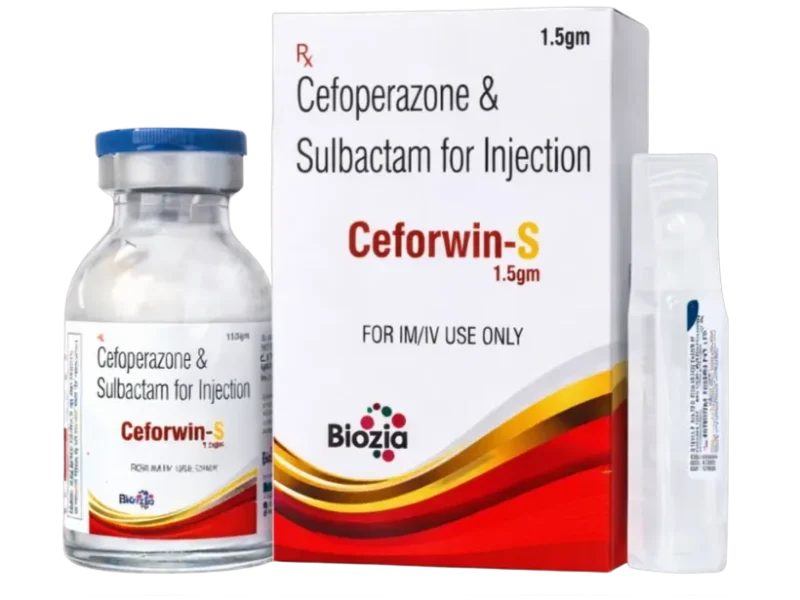
Ceforwin-S 1.5 gm Injection
Cefoperazone Sodium Sterile IP 1000 mg + Sulbactum Sodium Sterile IP 500 mg (IV/IM use only)
| Composition | Cefoperazone Sodium Sterile IP 1000 mg + Sulbactum Sodium Sterile IP 500 mg (IV/IM use only) |
|---|---|
| Packing | 20ml vial + 10ml D/w (carton) |
| MRP | ₹ 287 |
| Dosage Form | Injections |
About Ceforwin-S 1.5 gm Injection
Ceforwin-S 1.5 gm Injection contains Cefoperazone Sodium 1000 mg and Sulbactam Sodium 500 mg, a powerful parenteral antibiotic combination for hospital use (IV/IM administration only). Cefoperazone is a third-generation cephalosporin antibiotic with a broad spectrum of antibacterial activity, and Sulbactam is a beta-lactamase inhibitor that protects Cefoperazone from destruction by resistant bacteria.
Ceforwin-S is administered in hospital settings by trained healthcare professionals for the treatment of moderate-to-severe bacterial infections. The addition of Sulbactam extends the antibacterial coverage to include beta-lactamase-producing organisms that would otherwise be resistant to Cefoperazone alone, making this combination an important tool in serious infection management.
Uses of Ceforwin-S 1.5 gm Injection
This medicine is commonly used for:
- Severe respiratory tract infections including pneumonia
- Serious urinary tract and kidney infections
- Intra-abdominal and gynecological infections
- Skin, soft tissue, and bone infections caused by susceptible bacteria
- Septicemia (bloodstream infections) caused by susceptible organisms
Indications
Cefoperazone 1000 mg + Sulbactam 500 mg IV/IM is indicated for the treatment of serious infections caused by susceptible organisms, including lower respiratory tract infections (community-acquired and hospital-acquired pneumonia), complicated urinary tract infections, intra-abdominal infections (peritonitis, biliary tract infections), pelvic inflammatory disease, skin and soft tissue infections, bone and joint infections, and septicemia. The sulbactam component extends coverage to beta-lactamase-producing strains of Acinetobacter baumannii, Haemophilus influenzae, Bacteroides species, and Enterobacteriaceae.
How Ceforwin-S 1.5 gm Injection Works
Ceforwin-S works by attacking the bacterial cell wall. Bacteria need a strong, intact cell wall to survive. Cefoperazone interferes with the enzymes bacteria use to build this wall, causing it to weaken and the bacteria to die. Sulbactam serves as a shield — it blocks the enzymes some resistant bacteria use to destroy antibiotics, keeping Cefoperazone active and effective even against tougher organisms.
Mechanism of Action
Cefoperazone is a third-generation cephalosporin that inhibits bacterial cell wall synthesis by binding to penicillin-binding proteins (PBPs), particularly PBP1a, PBP1b, and PBP3, impairing transpeptidation and crosslinking of peptidoglycan strands, leading to cell wall lysis and bacterial death. Sulbactam is an irreversible beta-lactamase inhibitor that forms a stable covalent acyl-enzyme intermediate with class A and class C beta-lactamases, protecting Cefoperazone from enzymatic degradation. Additionally, Sulbactam has intrinsic antibacterial activity against Acinetobacter baumannii via PBP binding, making the combination particularly valuable in Acinetobacter infections.
Key Benefits
- Broad-spectrum coverage extended by Sulbactam against resistant, beta-lactamase-producing bacteria
- Effective against Acinetobacter baumannii — a challenging hospital-acquired pathogen
- Available for both IV and IM administration to suit clinical requirements
- Established combination for severe hospital-acquired and community-acquired infections
Did You Know?
Cefoperazone is one of the few cephalosporins that is predominantly excreted through bile rather than the kidneys, which makes it a useful option for treating biliary tract infections — and also means that patients with kidney disease usually do not need a dose reduction (unlike most other cephalosporins).
When & How to Take
Ceforwin-S 1.5 gm Injection is administered only by a healthcare professional in a hospital or clinical setting via the IV or IM route. Dosage and frequency are determined by the treating doctor based on the type and severity of infection, the patient's renal function, and the susceptibility of the infecting organism. Do not self-administer.
Always follow the dosage and schedule advised by your doctor — this is general guidance only.
Possible Side Effects
Ceforwin-S is generally well tolerated. Possible side effects include diarrhea, rash, mild pain or discomfort at the injection site, and transient elevation of liver enzymes. Rarely, hypersensitivity reactions may occur. Like all cephalosporins, it may cause antibiotic-associated diarrhea. Tell your doctor if any side effect is severe or persistent.
Precautions & Safety
- For IV/IM use only — must be administered by a trained healthcare professional
- Inform your doctor of any allergy to penicillins or cephalosporins before administration
- Liver function should be monitored in patients receiving prolonged courses, as Cefoperazone is primarily excreted via bile
- Avoid alcohol during and for at least 5 days after completing the course — Cefoperazone can cause a disulfiram-like reaction with alcohol
- Dose adjustment may be required in patients with combined hepatic and renal impairment
Myths vs Facts
Injectable antibiotics are always stronger than oral antibiotics and should be used first.
Injectable antibiotics like Ceforwin-S are reserved for serious or hospital-acquired infections where oral therapy is not practical or sufficient. For many community infections, well-chosen oral antibiotics achieve equivalent outcomes. The route is chosen based on severity, site of infection, and the patient's ability to absorb oral medicines.
You can stop the antibiotic injection course early once you feel better.
Stopping an antibiotic course prematurely — even when feeling better — can leave residual bacteria that may regrow and become harder to treat. The full prescribed course must be completed under medical supervision.