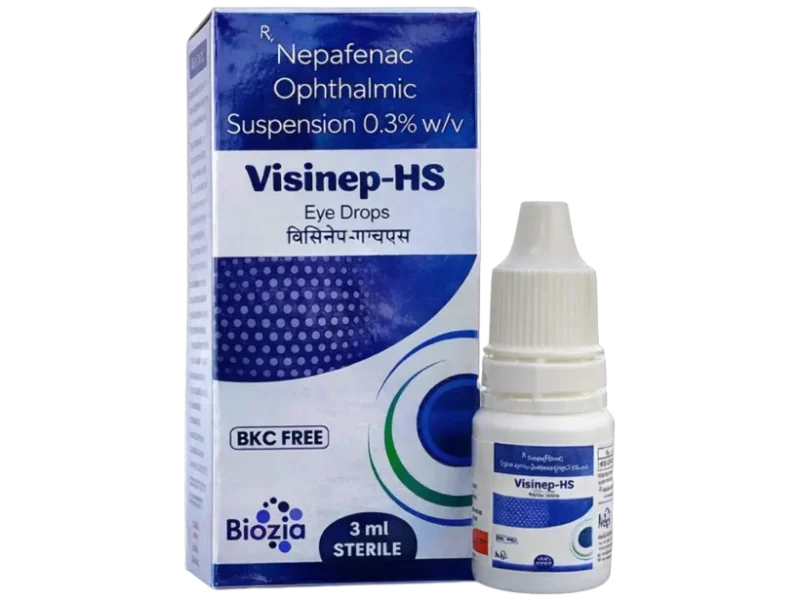
Visinep HS Eye Drop
Nepafenac 0.3% w/v
| Composition | Nepafenac 0.3% w/v |
|---|---|
| Packing | 3ml |
| MRP | ₹ 295 |
| Dosage Form | Eye Drops |
About Visinep HS Eye Drop
Visinep HS Eye Drop contains Nepafenac 0.3% w/v, a non-steroidal anti-inflammatory drug (NSAID) formulated for ophthalmic use. Nepafenac is a prodrug that penetrates the cornea and converts to its active form inside the eye, providing targeted anti-inflammatory and analgesic action where it is needed most.
Visinep HS is the high-strength (HS) formulation of Nepafenac, prescribed by ophthalmologists for pain and inflammation management associated with eye surgery — particularly cataract surgery.
Uses of Visinep HS Eye Drop
This medicine is commonly used for:
- Relieving pain and inflammation in the eye following cataract surgery
- Reducing post-operative eye discomfort after ophthalmic procedures
- Managing inflammation following certain corneal or retinal surgeries
- Reducing the risk of macular oedema after cataract surgery (as directed by an ophthalmologist)
- Providing targeted pain control in the eye as an alternative to steroids when indicated
Indications
Indicated for the treatment and prevention of post-operative ocular pain and inflammation following cataract extraction. Nepafenac 0.3% once-daily dosing is indicated for management of post-cataract surgery inflammation and reduction of the risk of macular oedema associated with cataract surgery. Use is under ophthalmological supervision.
How Visinep HS Eye Drop Works
When Nepafenac is applied to the eye, it passes through the cornea and is converted by enzymes inside the eye into its active form, Amfenac. Amfenac then reduces the production of inflammatory chemicals called prostaglandins, which are responsible for pain, swelling, and redness after eye surgery.
Mechanism of Action
Nepafenac is an amide prodrug of Amfenac that undergoes enzymatic hydrolysis by ocular tissue amidases, particularly in the iris-ciliary body, to generate the pharmacologically active metabolite Amfenac. Amfenac is a potent inhibitor of both cyclooxygenase-1 (COX-1) and cyclooxygenase-2 (COX-2), blocking arachidonic acid conversion to prostaglandins and thromboxanes. Reduction in prostaglandin synthesis results in decreased vascular permeability, reduced miosis, and decreased post-operative pain and inflammation. The prodrug design enables superior corneal penetration compared to active acid NSAIDs.
Key Benefits
- Prodrug design allows superior penetration through the cornea to reach intraocular tissues
- Once-daily dosing (0.3% strength) provides convenient post-surgical management
- Reduces post-operative pain and inflammation without the risks of steroid eye drops when used appropriately
- Helps protect against macular oedema — a significant complication of cataract surgery
Did You Know?
Nepafenac's prodrug design was specifically created to overcome the challenge of getting anti-inflammatory drugs into the interior of the eye — the cornea acts as a natural barrier. By designing the molecule to activate only after crossing the cornea, it achieves much higher concentrations inside the eye where the inflammation actually occurs.
When & How to Take
Use Visinep HS Eye Drop exactly as prescribed by your ophthalmologist — typically beginning before surgery and continuing for a specified post-operative period. Do not alter the prescribed frequency or duration. Your surgeon will give you detailed instructions on when and how to apply the drops.
Always follow the dosage and schedule advised by your doctor — this is general guidance only.
Possible Side Effects
Some patients may experience mild eye irritation, stinging, or discomfort after instillation. Temporary blurring of vision may occur. Less commonly, surface irritation to the cornea may develop with prolonged NSAID use, so follow the prescribed duration strictly. Tell your doctor if any side effect is severe or persistent.
Precautions & Safety
- For ophthalmic use only — prescribed and supervised use by an ophthalmologist
- Inform your doctor if you have bleeding disorders or are taking blood-thinning medications
- Do not wear contact lenses during the post-surgical period unless specifically advised
- Avoid rubbing your eyes during the treatment period
- Inform your doctor if you have had any previous corneal surgeries or corneal conditions
Myths vs Facts
Anti-inflammatory eye drops after surgery are optional if your eye does not feel painful.
Post-operative inflammation can occur even without obvious pain, and complications like macular oedema can develop silently. Following your surgeon's prescribed eye drop regimen, including anti-inflammatory drops like Visinep HS, is essential for a good surgical outcome.
NSAID eye drops are the same as steroid eye drops and can be used interchangeably.
NSAIDs like Nepafenac and corticosteroid eye drops work through different mechanisms. They may be prescribed together or as alternatives depending on the clinical situation. Only your ophthalmologist can determine the right anti-inflammatory approach for your surgery.