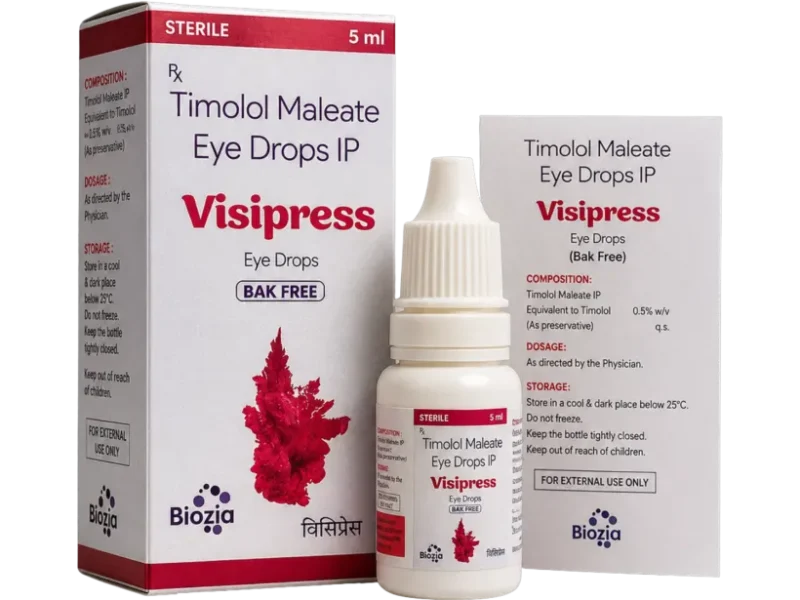
Visipress Eye Drop
Timolol Meleate 0.5% w/v
| Composition | Timolol Meleate 0.5% w/v |
|---|---|
| Packing | 5ml |
| MRP | ₹ 70 |
| Dosage Form | Eye Drops |
About Visipress Eye Drop
Visipress Eye Drop contains Timolol Maleate 0.5% w/v, a well-established beta-adrenergic blocker used in ophthalmology to lower elevated intraocular pressure (IOP). Raised intraocular pressure is the primary risk factor for glaucoma — a serious eye condition that can lead to irreversible vision loss if untreated.
Visipress Eye Drop is prescribed by ophthalmologists as part of the long-term management of open-angle glaucoma and ocular hypertension, helping to protect the optic nerve from damage caused by elevated eye pressure.
Uses of Visipress Eye Drop
This medicine is commonly used for:
- Lowering elevated intraocular pressure (IOP) in glaucoma management
- Managing open-angle glaucoma to protect the optic nerve
- Treating ocular hypertension (raised eye pressure without glaucoma damage)
- Preventing vision loss associated with uncontrolled intraocular pressure
- Used as monotherapy or alongside other anti-glaucoma eye drops as directed by an ophthalmologist
Indications
Indicated for the reduction of elevated intraocular pressure in patients with ocular hypertension and open-angle glaucoma. Timolol maleate 0.5% is a standard first-line or adjunctive anti-glaucoma agent, prescribed under ophthalmological supervision with regular IOP monitoring.
How Visipress Eye Drop Works
The eye constantly produces a fluid called aqueous humour that helps maintain eye shape. In glaucoma, this fluid does not drain properly and pressure builds up. Timolol works by reducing the amount of aqueous humour produced by the eye, which lowers the pressure inside the eye and reduces the strain on the optic nerve.
Mechanism of Action
Timolol maleate is a non-selective beta-adrenergic antagonist (beta-1 and beta-2) that, when applied topically, reduces intraocular pressure primarily by decreasing the production of aqueous humour by the ciliary body epithelium. This effect is mediated by blockade of beta-2 adrenoceptors, reducing cAMP-mediated aqueous humour secretion. Timolol has no intrinsic sympathomimetic activity and does not affect aqueous humour outflow to a clinically significant degree. A meaningful proportion of the dose is systemically absorbed via the nasolacrimal drainage system.
Key Benefits
- Well-established, decades-proven first-line agent for reducing intraocular pressure
- Effective once or twice-daily dosing for convenient long-term glaucoma management
- Reduces aqueous humour production consistently to maintain lower IOP
- Widely used and extensively studied ophthalmic beta-blocker
Did You Know?
Timolol eye drops are absorbed into the bloodstream through the nasolacrimal drainage system and can have meaningful effects on the heart and lungs — even though it is applied to the eye. This is why ophthalmologists carefully screen patients' cardiac and respiratory history before prescribing Timolol drops. Simply pressing gently on the inner corner of the eye for a minute after instillation can significantly reduce this systemic absorption.
When & How to Take
Use Visipress Eye Drop exactly as prescribed by your ophthalmologist — typically once or twice daily in the affected eye(s). Apply at the same time(s) each day for consistent pressure control. Do not stop using this drop without consulting your doctor, even if your eyes feel comfortable.
Always follow the dosage and schedule advised by your doctor — this is general guidance only.
Possible Side Effects
Local side effects may include mild stinging or redness in the eye after instillation. Because Timolol is absorbed into the bloodstream via the nasolacrimal duct, systemic effects such as slow heart rate, low blood pressure, fatigue, or breathlessness can occur — particularly in patients with heart or lung conditions. Tell your doctor if any side effect is severe or persistent.
Precautions & Safety
- Inform your doctor if you have asthma, COPD, heart failure, or a slow heart rate — beta-blockers can worsen these conditions
- Do not stop using Visipress suddenly without consulting your ophthalmologist
- Apply nasolacrimal occlusion (press gently on the inner corner of the eye after instillation) to reduce systemic absorption
- Inform all your doctors, including your GP and cardiologist, that you are using a beta-blocker eye drop
- Regular IOP monitoring with your ophthalmologist is essential during treatment
Myths vs Facts
If my eyes feel normal, I don't need to keep using glaucoma eye drops.
Glaucoma is often painless and causes no symptoms until significant vision loss has occurred. Regular use of prescribed eye drops like Visipress is essential for preventing optic nerve damage and vision loss, even when your eyes feel perfectly comfortable.
Eye drops only affect the eyes and have no effect on the rest of the body.
Timolol eye drops are absorbed into the bloodstream and can affect the heart and lungs. This is why it is important to inform all your doctors — including your GP and cardiologist — that you are using these drops.