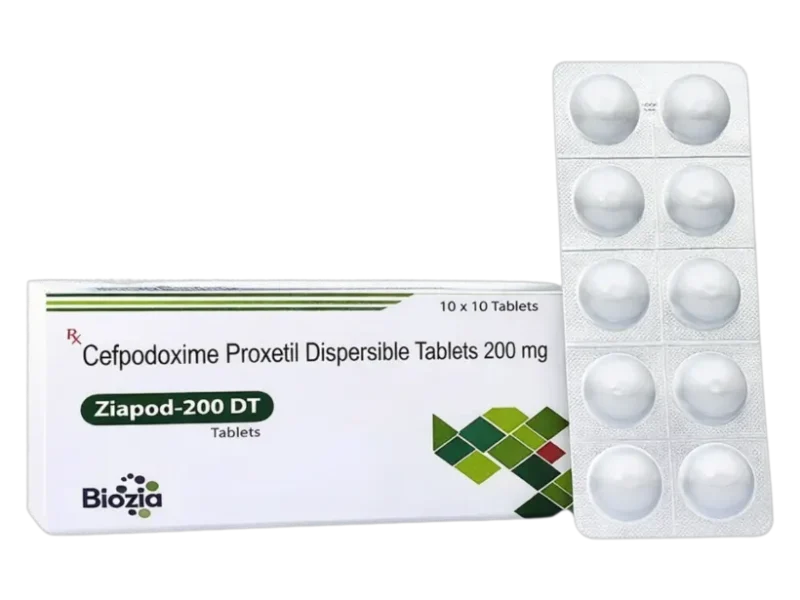
Ziapod-200 DT Tablet
Cefpodoxime 200 mg (Dispersible Tabletlet)
| Composition | Cefpodoxime 200 mg (Dispersible Tabletlet) |
|---|---|
| Packing | 10x10 Alu/Alu |
| MRP | ₹ 2850 |
| Dosage Form | Tablets |
About Ziapod-200 DT Tablet
Ziapod-200 DT Tablet contains Cefpodoxime 200 mg as a dispersible tablet — a higher-strength formulation of this broad-spectrum third-generation oral cephalosporin antibiotic, suitable for more demanding bacterial infections.
The dispersible form dissolves in water for easy swallowing, and the 200 mg strength provides the higher dose often needed to treat moderate bacterial infections effectively.
Uses of Ziapod-200 DT Tablet
This medicine is commonly used for:
- Community-acquired pneumonia and lower respiratory tract infections
- Acute exacerbations of chronic bronchitis
- Complicated urinary tract infections
- Sexually transmitted infections caused by susceptible organisms
- Skin and soft tissue infections requiring a higher antibiotic dose
Indications
Cefpodoxime 200 mg is indicated for moderate bacterial infections including community-acquired pneumonia, acute exacerbations of chronic bronchitis, uncomplicated gonorrhoea, and complicated urinary tract infections caused by susceptible Gram-positive and Gram-negative organisms. The 200 mg dose provides a higher bactericidal exposure suitable for pathogens requiring greater antibiotic concentration.
How Ziapod-200 DT Tablet Works
Like all cephalosporins, Cefpodoxime destroys bacteria by breaking down their protective cell wall, causing them to rupture and die. The 200 mg dose provides a higher antibacterial concentration in the blood and tissues, reaching areas of deeper or more severe infection more effectively.
Mechanism of Action
Cefpodoxime proxetil is a prodrug hydrolysed to active Cefpodoxime by intestinal esterases. Active Cefpodoxime binds to penicillin-binding proteins (PBPs 1a, 1b, 2, 3) in the bacterial cell wall, inhibiting transpeptidase-mediated peptidoglycan cross-linking. This disrupts cell wall integrity leading to osmotic lysis. The higher 200 mg dose achieves pharmacokinetic/pharmacodynamic (PK/PD) targets — time above MIC — for organisms with moderately elevated minimum inhibitory concentrations, including many beta-lactamase-producing strains.
Key Benefits
- Higher-strength formulation for moderate to more demanding bacterial infections
- Dispersible tablet enables easy administration for those with swallowing difficulty
- Broad-spectrum activity covers both Gram-positive and Gram-negative pathogens
- Good tissue penetration achieves therapeutic concentrations at infection sites
Did You Know?
The effectiveness of cephalosporins like Cefpodoxime depends on the length of time the blood level stays above the bacteria's minimum inhibitory concentration — which is why consistent, on-time dosing throughout the day is just as important as taking the correct total dose.
When & How to Take
Dissolve Ziapod-200 DT Tablet in water and take with food as directed by your doctor. Always complete the full course of treatment prescribed, even if you feel better before the course is finished.
Always follow the dosage and schedule advised by your doctor — this is general guidance only.
Possible Side Effects
Side effects are similar to the 100 mg tablet and may include nausea, diarrhoea, stomach discomfort, or headache. Hypersensitivity reactions are uncommon but possible, especially in patients with penicillin allergy. Tell your doctor if any side effect is severe or persistent.
Precautions & Safety
- Inform your doctor of any allergy to penicillins or other cephalosporins before starting
- Take with food to maximise absorption and minimise gastrointestinal effects
- Complete the full prescribed course without interruption
- Consult your doctor before use during pregnancy or breastfeeding
- Patients with renal impairment may require dose adjustment — inform your doctor
Myths vs Facts
A stronger antibiotic tablet is always better and will work faster.
The right antibiotic dose is determined by the type and severity of infection, the causative organism, and your individual health status. Using too high a dose unnecessarily increases the risk of side effects and antibiotic resistance.
If diarrhoea starts after antibiotics, the medicine is not working.
Mild diarrhoea is a common and expected side effect of many antibiotics, including cephalosporins. It usually resolves after the course ends. Contact your doctor only if it is severe or persistent.