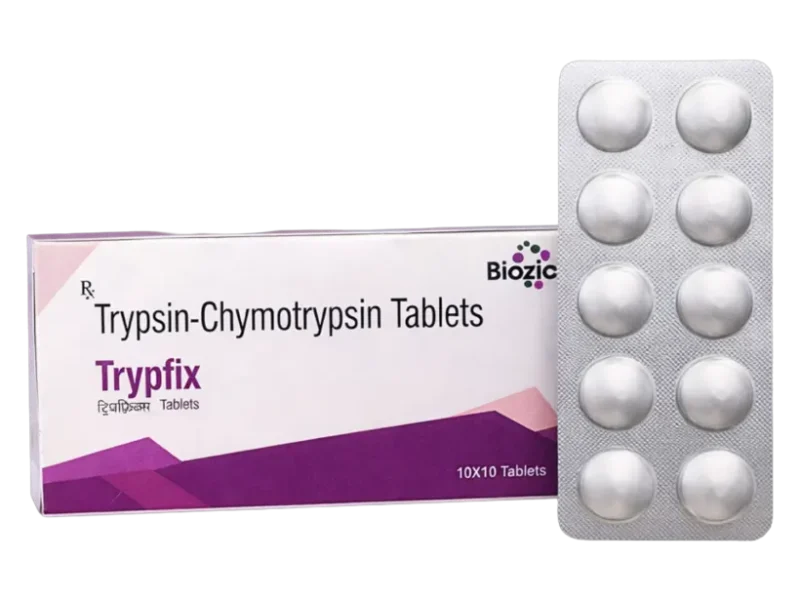
Trypfix Tablet
Trypsin-Chymotrypsin 100000 units of enzymatic activity
| Composition | Trypsin-Chymotrypsin 100000 units of enzymatic activity |
|---|---|
| Packing | 10x10 ALU/ALU |
| MRP | ₹ 2100 |
| Dosage Form | Tablets |
About Trypfix Tablet
Trypfix Tablet is an anti-inflammatory enzyme tablet containing Trypsin-Chymotrypsin 100,000 units of enzymatic activity. This combination of two proteolytic enzymes — Trypsin and Chymotrypsin — works by breaking down proteins involved in inflammation and oedema at injury or surgical sites, supporting the body's natural healing process.
Trypfix is commonly prescribed as an adjunct therapy to reduce post-operative, post-traumatic, and inflammatory swelling and bruising. The dual enzyme formula provides complementary proteolytic activity across a broader range of protein substrates, potentially offering more complete anti-oedematous action compared to single-enzyme preparations.
Uses of Trypfix Tablet
This medicine is commonly used for:
- Reducing swelling and oedema after surgery or injury
- Anti-inflammatory support for bruising and haematomas
- Adjunct therapy in musculoskeletal inflammatory conditions
- Post-dental procedure swelling and pain management
- Supporting resolution of sports-related soft tissue injuries
Indications
Trypsin-Chymotrypsin combination at 100,000 units enzymatic activity is indicated as an adjunct anti-oedematous and anti-inflammatory agent in post-operative oedema, post-traumatic swelling, haematomas, inflammatory musculoskeletal conditions, and dental surgical recovery. The proteolytic activity facilitates fibrinolysis, degradation of inflammatory mediators, and resolution of exudative oedema, supporting faster tissue repair.
How Trypfix Tablet Works
Trypfix contains two powerful natural enzymes — Trypsin and Chymotrypsin — that, when absorbed into the bloodstream, travel to sites of inflammation and injury. There, they break down proteins that make up the fluid and debris that accumulate in swollen tissue. By clearing this inflammatory protein buildup, the swelling reduces, blood circulation to the area improves, and the healing process is accelerated.
Mechanism of Action
Trypsin is a serine endopeptidase that cleaves peptide bonds at the carboxyl side of lysine and arginine residues, degrading fibrin, fibrinogen, bradykinin, complement proteins, and pro-inflammatory cytokines. Chymotrypsin cleaves at the carboxyl side of aromatic and bulky hydrophobic amino acid residues (phenylalanine, tryptophan, tyrosine), targeting a complementary set of inflammatory substrates. Administered orally and absorbed via the GI mucosa into systemic circulation, the two enzymes act synergistically at inflammatory loci to reduce oedematous protein accumulation, modulate neutrophil migration, and support microvascular permeability normalisation. This facilitates fibrinolysis and accelerated resolution of post-inflammatory exudate.
Key Benefits
- Dual-enzyme system provides broader proteolytic activity than single-enzyme alternatives
- Effectively reduces post-surgical and post-traumatic swelling
- Supports natural healing by clearing inflammatory protein buildup
- Well-established anti-oedematous action recognised in clinical practice
Did You Know?
Chymotrypsin, one of the enzymes in Trypfix, was among the first enzymes to be crystallised in pure form (by Nobel laureate James Sumner and John Northrop in the 1930s), paving the way for the understanding of enzyme-based therapies in medicine.
When & How to Take
Trypfix Tablet should ideally be taken on an empty stomach — at least 30 minutes before a meal or 2 hours after — so the enzymes are absorbed into the bloodstream rather than used for digestion, unless your doctor advises otherwise. Follow the dosage and duration prescribed by your doctor exactly.
Always follow the dosage and schedule advised by your doctor — this is general guidance only.
Possible Side Effects
Trypfix is generally well-tolerated. Some people may experience mild nausea, stomach discomfort, or loose stools. Allergic reactions are rare but possible. Tell your doctor if any side effect is severe or persistent.
Precautions & Safety
- Take on an empty stomach for optimal systemic absorption, unless instructed otherwise
- Inform your doctor if you are on anticoagulant or antiplatelet medications
- Not a substitute for prescribed pain medications after surgery
- Consult your doctor before use during pregnancy or breastfeeding
- Inform your doctor of any known allergy to enzyme-based products
Myths vs Facts
Enzyme tablets work only when taken with food.
Proteolytic enzymes like Trypsin-Chymotrypsin are best absorbed on an empty stomach. When taken with food, they are largely used to digest food rather than being absorbed into the bloodstream to act on inflammation.
Enzyme anti-inflammatory tablets are just digestive aids with no real medical use.
Systemically absorbed proteolytic enzymes are clinically studied for their anti-oedematous and anti-inflammatory properties and are widely used in post-surgical and trauma care as adjunct treatments.