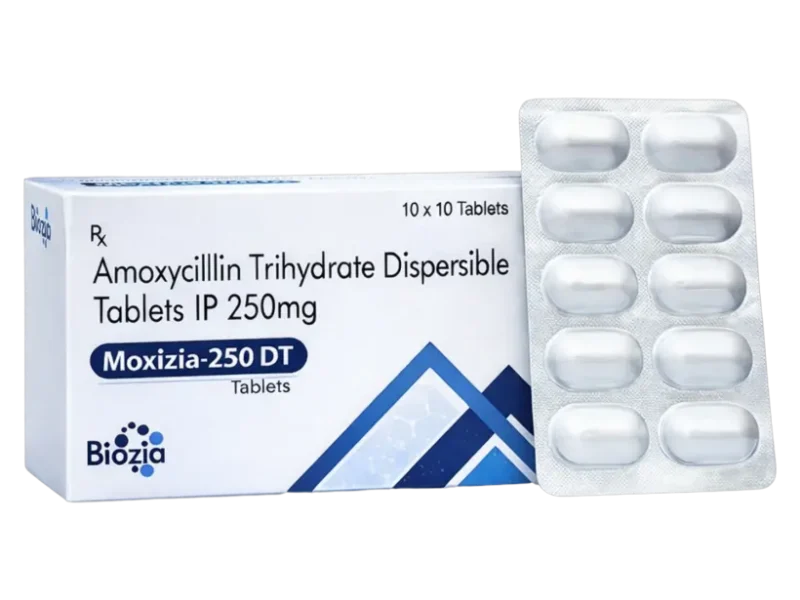
Moxizia-250 DT Tablet
Amoxycillin 250 mg (Dispersible Tablet)
| Composition | Amoxycillin 250 mg (Dispersible Tablet) |
|---|---|
| Packing | 10x10 Alu/Alu |
| MRP | ₹ 900 |
| Dosage Form | Tablets |
About Moxizia-250 DT Tablet
Moxizia-250 DT Tablet is a dispersible tablet formulation containing Amoxycillin 250 mg — one of the most widely used and trusted penicillin-class antibiotics worldwide. The dispersible tablet format dissolves easily in water, making it particularly well-suited for children and adults who have difficulty swallowing conventional tablets, while delivering the same trusted antibiotic efficacy.
Produced by Biozia Lifesciences, Moxizia-250 DT is effective against a broad range of common gram-positive and gram-negative bacterial infections. Its excellent safety record, good tolerability, and convenient formulation make it a go-to antibiotic for community-acquired infections in both paediatric and adult patients.
Uses of Moxizia-250 DT Tablet
This medicine is commonly used for:
- Treating respiratory infections including throat infections, tonsillitis, bronchitis, and community-acquired pneumonia
- Managing ear infections (otitis media) and sinus infections
- Treating urinary tract infections caused by susceptible bacteria
- Managing skin and soft tissue infections
- Treating H. pylori-associated gastric ulcers as part of combination eradication therapy
Indications
Amoxycillin 250 mg is indicated for the treatment of infections caused by susceptible organisms including upper and lower respiratory tract infections (Streptococcus pneumoniae, Haemophilus influenzae, Streptococcus pyogenes), acute otitis media, urinary tract infections (Escherichia coli, Proteus mirabilis, Enterococcus faecalis), skin and soft tissue infections, and as a component of Helicobacter pylori eradication regimens. The dispersible tablet formulation enables precise dose administration and improved compliance particularly in paediatric patients.
How Moxizia-250 DT Tablet Works
Amoxycillin in Moxizia-250 DT works by attacking the cell wall of bacteria. Bacteria need a strong, intact cell wall to survive, and amoxycillin interferes with the special enzymes they use to build and maintain it. Without a functional cell wall, bacteria burst and die, clearing the infection. The dispersible formulation simply means the tablet can be dissolved in water for ease of swallowing — the antibiotic action is identical.
Mechanism of Action
Amoxycillin is a semisynthetic aminopenicillin beta-lactam antibiotic that exerts bactericidal activity by binding irreversibly to penicillin-binding proteins (PBPs 1a, 1b, and 2) on the bacterial cell membrane. This inhibits transpeptidation of the peptidoglycan cell wall, causing autolytic cell lysis mediated by bacterial autolysins. Amoxycillin has a wider spectrum than narrow-spectrum penicillins, covering many gram-positive and gram-negative organisms, though it is susceptible to hydrolysis by beta-lactamases. It achieves high oral bioavailability (~90%) and is acid-stable in the gastrointestinal tract.
Key Benefits
- One of the most widely trusted antibiotics with an exceptional long-term safety record across all age groups
- Dispersible formulation is ideal for children and patients who cannot swallow tablets whole
- High oral bioavailability means excellent systemic drug exposure from an oral dose
- Effective for many of the most common bacterial infections encountered in general practice
Did You Know?
Amoxycillin is derived from the original penicillin molecule discovered by Alexander Fleming in 1928, but was specifically engineered for broader bacterial coverage and better oral absorption — making it effective for far more infections than the original penicillin and one of the WHO's Essential Medicines.
When & How to Take
Take Moxizia-250 DT as directed by your doctor. Dissolve the tablet in a small amount of water and drink. It can be taken with or without food. Take doses at regular intervals as prescribed and always complete the full course, even if you feel better before it is finished.
Always follow the dosage and schedule advised by your doctor — this is general guidance only.
Possible Side Effects
Amoxycillin is generally very well tolerated. The most common side effects are mild diarrhoea, nausea, and stomach upset. Skin rash may occasionally occur — if a rash develops, inform your doctor as it could indicate an allergy. Allergic reactions, though uncommon, can be serious. Tell your doctor if any side effect is severe or persistent, or if you develop hives, swelling, or difficulty breathing.
Precautions & Safety
- Inform your doctor of any known allergy to penicillin or cephalosporin antibiotics before taking this medicine
- Complete the full prescribed course — stopping early can allow the infection to return and promote resistance
- Inform your doctor if you have kidney disease, as dose adjustment may be needed
- Amoxycillin can affect the results of certain urine glucose tests — tell your healthcare provider if you are diabetic and being monitored
- Consult your doctor before use during pregnancy or breastfeeding, though amoxycillin is generally considered safe under medical supervision
Myths vs Facts
Amoxycillin can treat a sore throat caused by a cold or flu.
The majority of sore throats are caused by viruses, against which antibiotics have no effect. Amoxycillin is effective only for bacterial throat infections (like strep throat). Your doctor will determine whether your sore throat is bacterial before prescribing an antibiotic.
If you are allergic to penicillin, all antibiotics are unsafe for you.
A penicillin allergy means you should avoid penicillin-class drugs (including amoxycillin). However, many other classes of antibiotics (macrolides, fluoroquinolones, cephalosporins with caution) are still safe. Your doctor can prescribe an appropriate alternative.