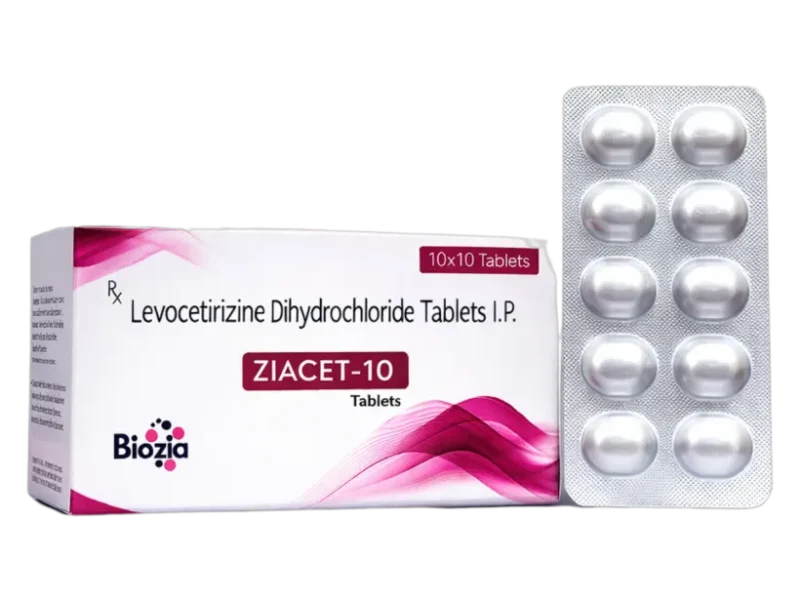
Ziacet-10 Tablet
Levocetirizine Dihydrochloride 10 mg
| Composition | Levocetirizine Dihydrochloride 10 mg |
|---|---|
| Packing | 10x10 Alu/Alu |
| MRP | ₹ 450 |
| Dosage Form | Tablets |
About Ziacet-10 Tablet
Ziacet-10 Tablet contains Levocetirizine Dihydrochloride 10 mg, a higher-strength formulation of the widely used second-generation antihistamine Levocetirizine. It is indicated for patients who require a stronger dose for more pronounced or persistent allergic symptoms, as directed by a doctor.
Like Ziacet-5, Ziacet-10 provides effective relief from sneezing, nasal discharge, eye irritation, and skin itching. The higher strength is particularly useful in more severe or difficult-to-control allergic conditions under medical supervision.
Uses of Ziacet-10 Tablet
This medicine is commonly used for:
- Managing moderate to severe seasonal and perennial allergic rhinitis
- Controlling chronic idiopathic urticaria and persistent skin itching
- Relieving eye symptoms of allergic conjunctivitis
- Addressing more pronounced or treatment-resistant allergic symptoms
- Providing sustained allergy relief when a lower dose is insufficient
Indications
Levocetirizine 10 mg is indicated for the symptomatic relief of allergic rhinitis and chronic idiopathic urticaria in adults, particularly in cases where a standard 5 mg dose provides inadequate symptom control. It is used under medical supervision for persistent or more severe histamine-mediated allergic conditions.
How Ziacet-10 Tablet Works
Ziacet-10 works the same way as its 5 mg counterpart — by blocking the histamine receptors that are responsible for allergy symptoms. The higher dose provides a stronger blockade of histamine activity, making it useful when symptoms are more intense or harder to control with a lower dose.
Mechanism of Action
Levocetirizine competitively antagonises peripheral H1-histamine receptors with high binding affinity, effectively attenuating histamine-mediated vasodilation, increased vascular permeability, smooth muscle contraction, and sensory nerve stimulation. At 10 mg, higher receptor occupancy is achieved, providing more complete suppression of histamine-driven inflammatory responses. The compound has negligible anticholinergic or adrenergic activity. CNS penetration remains limited at therapeutic concentrations, preserving its low-sedation profile relative to first-generation agents.
Key Benefits
- Higher strength for stronger, more reliable symptom control in difficult-to-treat cases
- Sustained 24-hour antihistamine effect supports once-daily dosing
- Selectively targets peripheral histamine receptors with limited central nervous system effects
- Effective for both respiratory and skin-related allergy symptoms
Did You Know?
Clinical studies have shown that levocetirizine binds to H1-receptors with about twice the affinity of its parent compound cetirizine — meaning each milligram delivers more antihistamine effect, which is why 10 mg of levocetirizine is a significant therapeutic dose used only under medical guidance.
When & How to Take
Ziacet-10 should be taken exactly as prescribed by your doctor. It is generally taken once daily, with or without food. Due to the higher dose, your doctor will guide you on the most appropriate timing and duration to suit your condition.
Always follow the dosage and schedule advised by your doctor — this is general guidance only.
Possible Side Effects
Mild drowsiness, headache, dry mouth, and fatigue may occur, especially at this higher dose. Some people may feel slightly more sedated than with the 5 mg strength. Tell your doctor if any side effect is severe or persistent.
Precautions & Safety
- Use with caution if you have kidney impairment — your doctor may adjust the dose accordingly
- Avoid alcohol and sedative medicines while taking this tablet as drowsiness may be increased
- Do not drive or operate machinery until you are confident of your alertness level on this dose
- This higher dose is for adults — seek specific medical advice before use in children or elderly patients
- Inform your doctor if you are pregnant, breastfeeding, or planning to become pregnant
Myths vs Facts
A higher antihistamine dose means stronger sedation.
Levocetirizine's sedation is primarily related to its limited ability to cross into the brain, not just dose. While the 10 mg strength may cause slightly more drowsiness than 5 mg, it is still far less sedating than older first-generation antihistamines like chlorpheniramine.
You can freely double your antihistamine dose if symptoms are bad.
Increasing the dose should always be done under a doctor's guidance. Ziacet-10 is a specific prescription-level dose — self-adjusting your antihistamine dose can lead to unnecessary side effects without guaranteed extra benefit.